
A practical guide
Content Strategy for SaaS Launches: Building Organic Momentum
A SaaS launch does not need a pile of posts. It needs a small set of pages that answer the questions a buyer already has, show the product doing the job, and stay accurate when the feature changes. Organic momentum is what those pages can do after the launch week is over. It is not a promise of rankings, leads, or a full calendar on day one.
I build founder-led software, and the content plan I trust looks like the product. Someone collects the real questions. Someone writes the explainer, the how-to, and the comparison. Someone records the same fact as a short demo. Someone reviews it before it is public. Then the month is measured, not admired. This page is that plan for a launch. The worked month for a fictional scheduling product already lives on the organic content plan for SaaS founders. I use the same kind of product here as the example, and I still do not have a customer’s results to attach to it.
The example is a scheduling tool a solo consultant might use. People book only during the hours the consultant set aside. The alternative is a chain of emails. That is enough product to plan a launch. It is not a case study, and it is not a claim that every SaaS should publish on the same schedule.
Identify the use cases and the questions
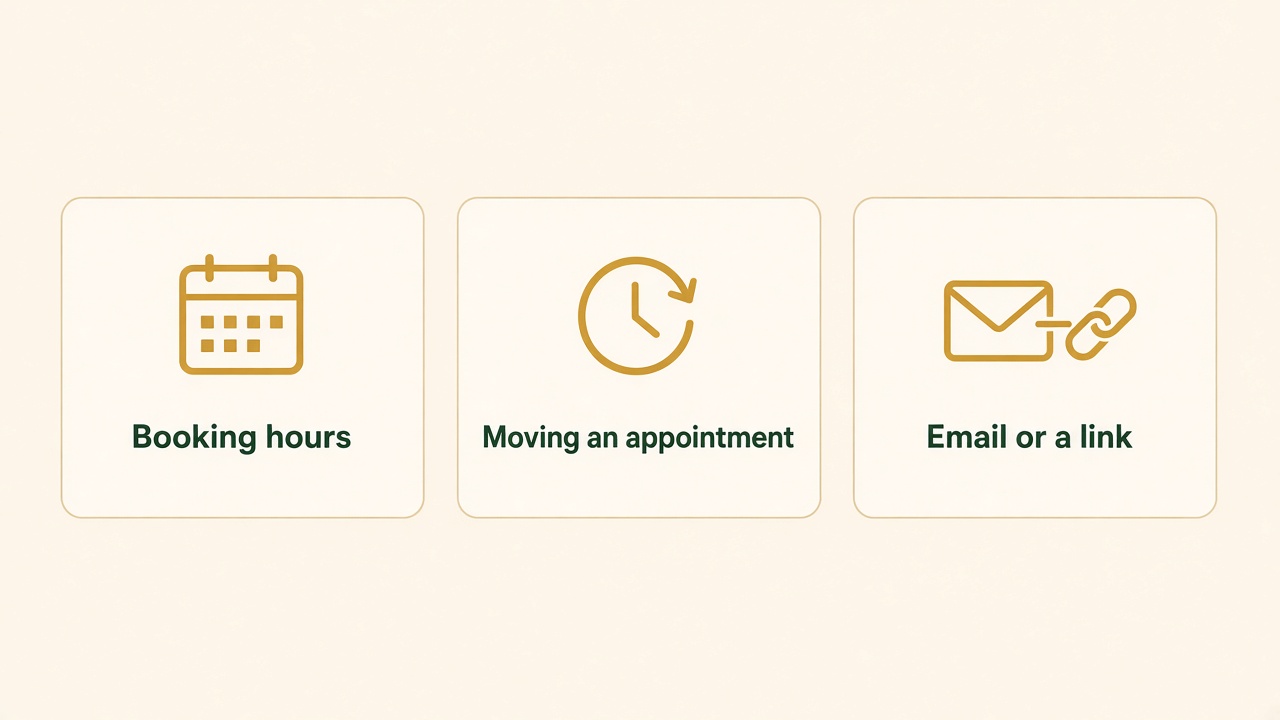
Questions a buyer already asks
These three are the hypothetical scheduling product, not a customer list and not a Verthilix feature. A launch page has to be able to show the answer in the product.
A launch strategy starts with a list of jobs, not a list of keywords. The job is what the buyer is trying to finish. For the scheduling example, the job is “let people book a time without a thread of emails, and only inside the hours I actually have.” The questions fall out of that job. Can a visitor book only the hours I set aside? What happens when I move an appointment? Is a booking link enough, or do I still need email? Those questions are specific enough to answer from the product. “Scheduling tips” is not. It can be answered by anyone, and it does not force you to show a screen.
Collect the questions from places you already have. Sales notes, support replies, onboarding calls, and the sentences people type into a trial. Write the situation, the tool they use today, and where they get stuck. Strip names before the note becomes a brief. Mark which questions repeat. A question that shows up three times is a page. A question that shows up once, about an edge you have not built, is a backlog item, not a launch article. The discipline is refusing topics you cannot verify. Google’s people-first guidance asks whether the page offers original information and a meaningful explanation, or whether you are writing because a topic looks like traffic. A launch calendar that fails that question will be busy and thin.
Separate the buyer’s question from the user’s question even when they share words. A prospect asking whether a booking link can replace email needs a comparison and an honest limit. A customer who already has the product and wants to test a booking page needs a setup guide. If you blend them, the prospect gets a tutorial they cannot follow yet, and the customer gets a pitch. Record the role on the brief: discover, compare, or complete a task. The next step on the page should match that role. A how-to points at the feature. A comparison points at a short demo of the difference. A setup article ends when the test booking works, not when you have repeated the homepage.
A use case also needs its conditions. If availability only works on one plan, or breaks when two people share a calendar, the page says so. If you cannot show the condition, narrow the question until you can. “Solo consultants setting consultation hours” is a use case you can film and write. “Enterprise scheduling for every industry” is a slogan. Founder-led marketing is allowed to be narrow at launch. The narrow page is the one a reader can trust, and it is the one you can keep true when the product changes.
How a SaaS startup grows with content, when it grows that way at all, is this list compounded. Each reviewed page remains after the launch email is forgotten. People who are not in your network can find the answer later. That is the organic part. It is not automatic. A page that does not match a real question, or that describes a feature you removed, does not compound. It becomes a correction. I would rather launch with five accurate URLs than thirty that a founder cannot defend on a call.
Choose the core content pillars
Three pillars are enough for a first launch: a feature explainer, a how-to, and a comparison. They match the way a buyer actually moves. They also stop the blog from becoming a magazine. Every later post should sit under one of them or earn a new pillar with a new job. A pillar is not a tag you add for organization. It is the promise that this group of pages shares one product fact and one kind of reader. Ahrefs’ guide to content marketing for SaaS describes the same restraint as product-led content: write about problems the product can actually solve, and show the product in the steps, rather than forcing it into a generic essay.
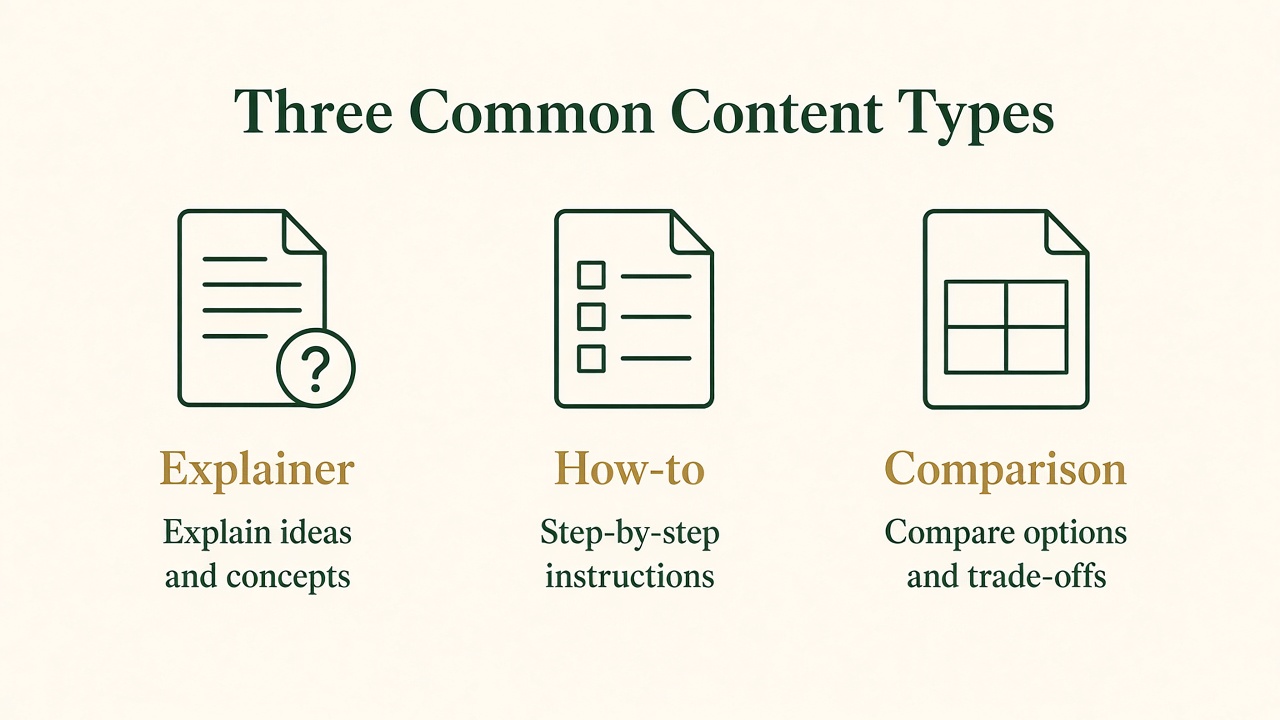
Explainer, how-to, and comparison
One page for what the feature does, one for the steps, and one for the choice against the process people use today.
The feature explainer says what the product does, who it is for, and the condition that matters before someone tries it. For scheduling, that page shows an owner setting availability and a visitor seeing only those hours. It does not teach every setting. It gives the feature a home so the how-to and the comparison have somewhere to point. If the homepage already does this job in full, do not clone it as a blog post with the nouns rearranged. Link to the homepage section, or write the explainer only where the homepage is too short to carry the limit.
The how-to is the product tutorial. It is the steps a person follows to finish the job once: set the hours, share the link, book a test appointment, and see what changes when the appointment moves. Screenshots or a short clip belong next to the step they illustrate. A tutorial that skips the failure (no hours set, the wrong time zone, a link sent before the calendar is connected) creates support load. Write the failure you have actually seen. Leave out the failure you are guessing.
The comparison is the decision page. The alternatives are the ones the buyer really has, not a table of logos. Email back-and-forth, a booking link, and a heavier shared calendar are enough for the consultant example. The criteria are things a reader can check: who can change the hours, how a booking is confirmed, and what happens to an exception. Say when email is still fine. A comparison that cannot admit a case for the old way is an ad. A comparison that hides a plan limit is a support ticket. Product-led content lives most naturally in the how-to and the comparison, because that is where the product is the means of solving the problem rather than the subject of a brochure.
What you should create for a new SaaS product is this trio, plus the one demo that shows the same fact. Add a second how-to only when a second job is real. Add a second comparison only when a second alternative is what buyers name. Topic clusters can come later, when you have queries and support notes that justify them. At launch, a cluster of twelve thin posts around “productivity” will not outrun one accurate how-to. Google’s people-first questions are a useful brake here: if you are producing many pages in the hope that some of them perform, stop and return to the three pillars.
Map the content to the funnel
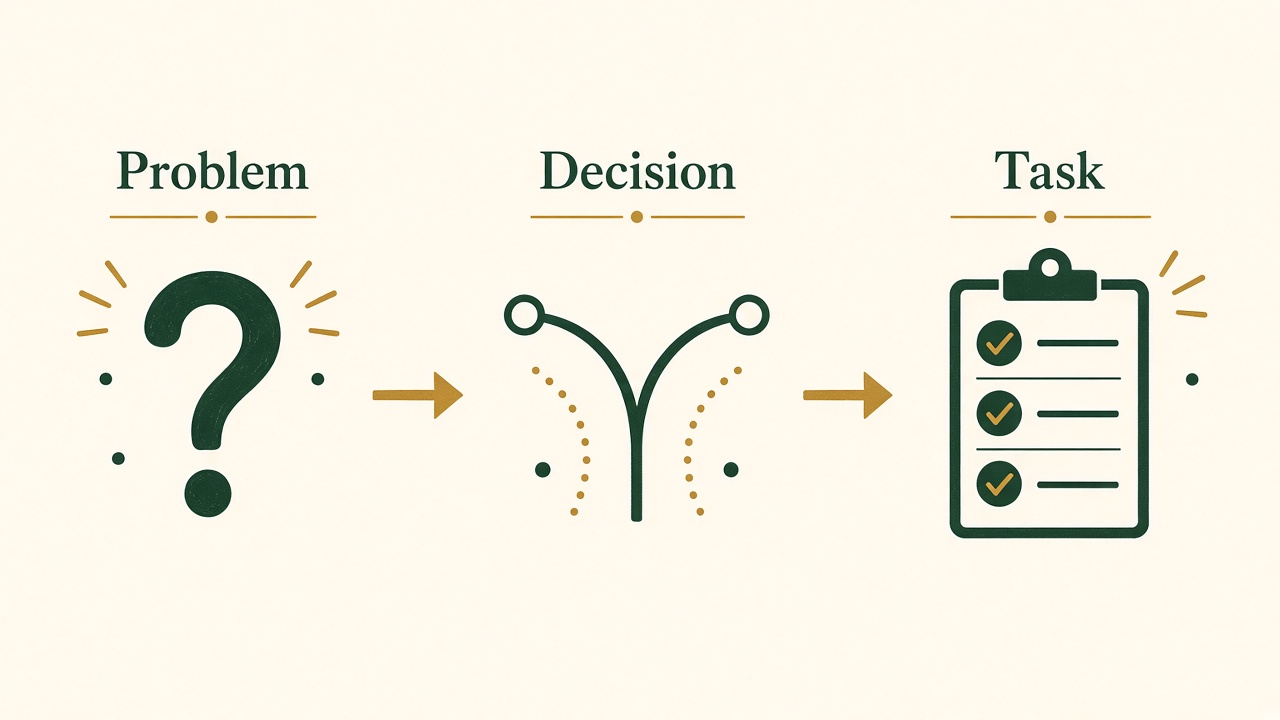
Problem, decision, then the task
Awareness explains the problem. The comparison helps the choice. The how-to is for someone ready to do the step. One page should not ask for all three.
A SaaS marketing funnel is a way to stop every page from asking for the same action. Awareness is the reader who has the problem and does not yet know your product is a candidate. Decision is the reader who is choosing between your product and the process they already have. After signup, the job changes again: they need to succeed, or they leave. Launch content usually over-serves the first group and ignores the third. The third group is where product-led content keeps a customer, not only where it finds one.
For the scheduling example, awareness is the cost of arranging meetings by email: the delays, the double bookings, the hours you did not mean to offer. That page can be useful to someone who never becomes a customer. It should still be accurate, and it should not pretend the only remedy is your signup. Decision is the comparison: booking link versus email, with the conditions. The call to action there can be a trial or a demo of that difference, because the reader is choosing. The how-to sits with people who are ready to try the steps, including new users. Pointing an awareness essay at “book a demo” as the only next step throws away the reader who wanted the explanation. Pointing a setup guide at a thought-leadership ending throws away the person who is stuck on a screen.
HubSpot’s guide to a content marketing plan notes that many teams publish mostly for the top of the funnel and neglect the middle and the bottom. A launch week makes that bias worse, because the announcement feels like the whole job. Plan the trio on purpose: one problem page, one decision page, one task page. If you only have time for two, keep the decision page and the how-to. The announcement can be a short post that links to them. It should not replace them. Lead generation content, in this plan, is the decision page and the how-to with a next step you can count. It is not a gated copy of the same article.
Write the stage on the calendar next to the title. When you review the month, you should be able to see whether you only shipped awareness. A founder who is also the writer will drift toward whatever is easiest to draft. Problem essays are often easier than a how-to that has to match the current UI. The funnel label is how you notice the drift before the launch is only a set of opinions.
Technical and non-technical readers are a funnel issue as well as a vocabulary issue. The consultant deciding whether to stop using email is non-technical in the sense that they need the outcome and the limit, not a data model. A buyer who will connect the tool to another system needs a different page: what is exported, who can change availability, how a time zone is stored, what an integration does not do. Do not write that page from a keyword. Write it when the product has the behavior and someone technical has checked the sentences. One page that tries to serve both readers usually satisfies neither. The non-technical reader bounces off the schema. The technical reader does not trust the simplified claim. Two URLs, linked to each other, are cheaper than one URL that is wrong for everyone.
Integrate the demo and the guide
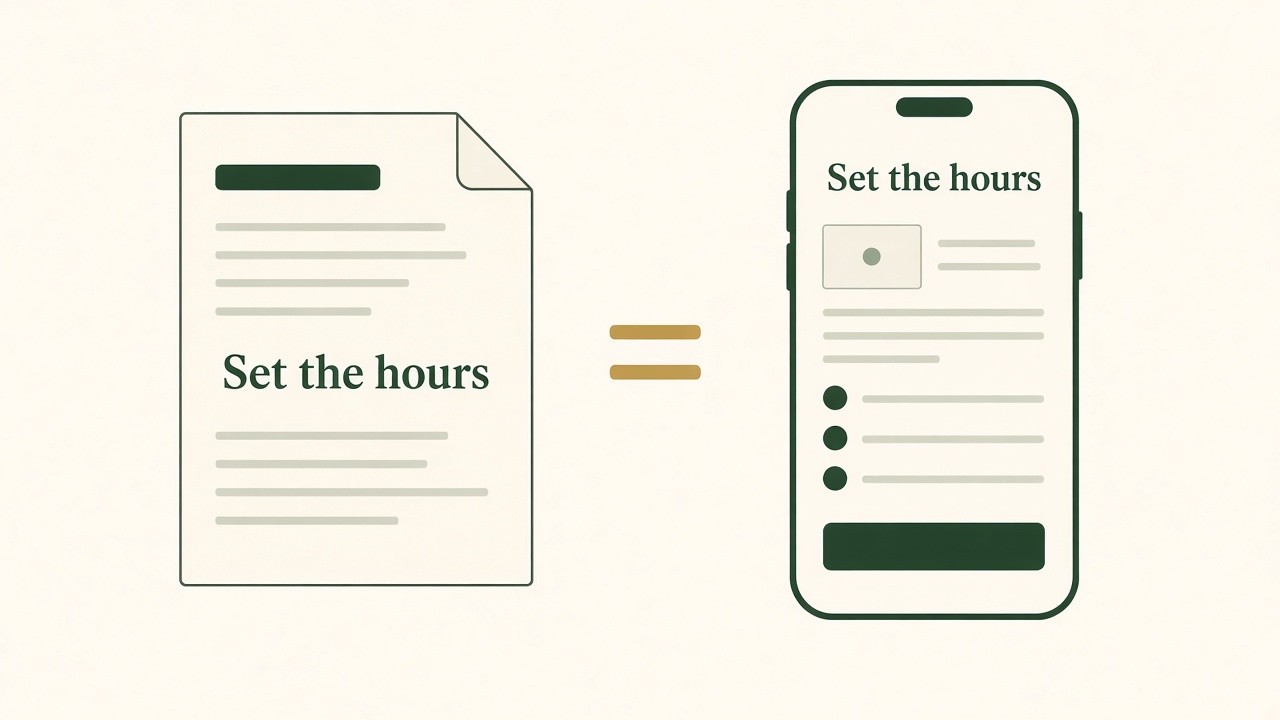
The same fact in both formats
The article carries the steps and the exceptions. The clip shows one moment. If they disagree, neither should go out. The video SEO guide covers titles, captions, and the watch page.
A guide tells the whole job. A demo shows one moment. Launch content gets stronger when they are the same fact, not two campaigns. The how-to says how a consultant sets consultation hours, shares the link, and books a test. The clip shows the visitor picking a time that exists only inside those hours. The article embeds the clip or links it beside that step. The clip’s caption links back to the article for the exceptions. A reader can start in either place and recognize the product.
Ahrefs’ explanation of product-led content is the right standard for the guide. Product-led content helps the reader solve a problem using your product. It is not a hard sell, and it is not every page that mentions the product. Help docs, announcements, and landing pages have other jobs. The launch how-to qualifies when the steps are real and the product is how you carry them out. It stops qualifying when the product appears as a paragraph of praise after a generic essay. Tim Soulo, Ahrefs’ CMO, describes the same sequence on Ahrefs’ article on why content marketing matters: people first learn how to use the tool, and they sign up because they already know how. I cite that as a description of the approach, not as a forecast for your signup rate.
This is also where the two tools I build can seed the launch without becoming the strategy. BloGoose is the article side: a draft of the how-to or the comparison from the site and from notes you maintain, which you still edit. Vlozy is the short video side: a vertical clip of the product moment, with a caption you review, that can go to Shorts, Reels, and TikTok. Together they are a guide plus a demo from the same website. They are not a strategist, and they do not decide the pillar. You choose the question. You check the UI in the clip against the steps in the article. If the button label moved, both wait. Vlozy & BloGoose for SaaS is the offer that pairs those workflows. The strategy on this page still works if you record the clip yourself and write the guide in another editor.
Do not make a separate video for the explainer, the how-to, and the comparison unless the moment on screen is actually different. One clip of a visitor booking an allowed hour can sit on the how-to and be linked from the comparison. A second clip is justified when you are showing the appointment move, because that is a second fact. Repurposing, in the launch sense, is this restraint. The social post uses the same sentence as the heading. It does not invent a benefit the article refused to claim. If you want the longer version of cutting one asset into another format, the content repurposing guide stays on that mechanic. Here, the rule is simply that the demo and the guide must not disagree in public.
Product tutorial content fails in a specific way at launch. The team films the happy path on a staging account that does not match production, or writes steps for a UI that ships next week. Hold the pair until the feature is in the build customers will see. A launch day with a late article is better than a launch day with a tutorial that 404s on step three. The announcement can say the feature is live and link to the guide when the guide is true. It should not link to a promise.
Schedule the releases
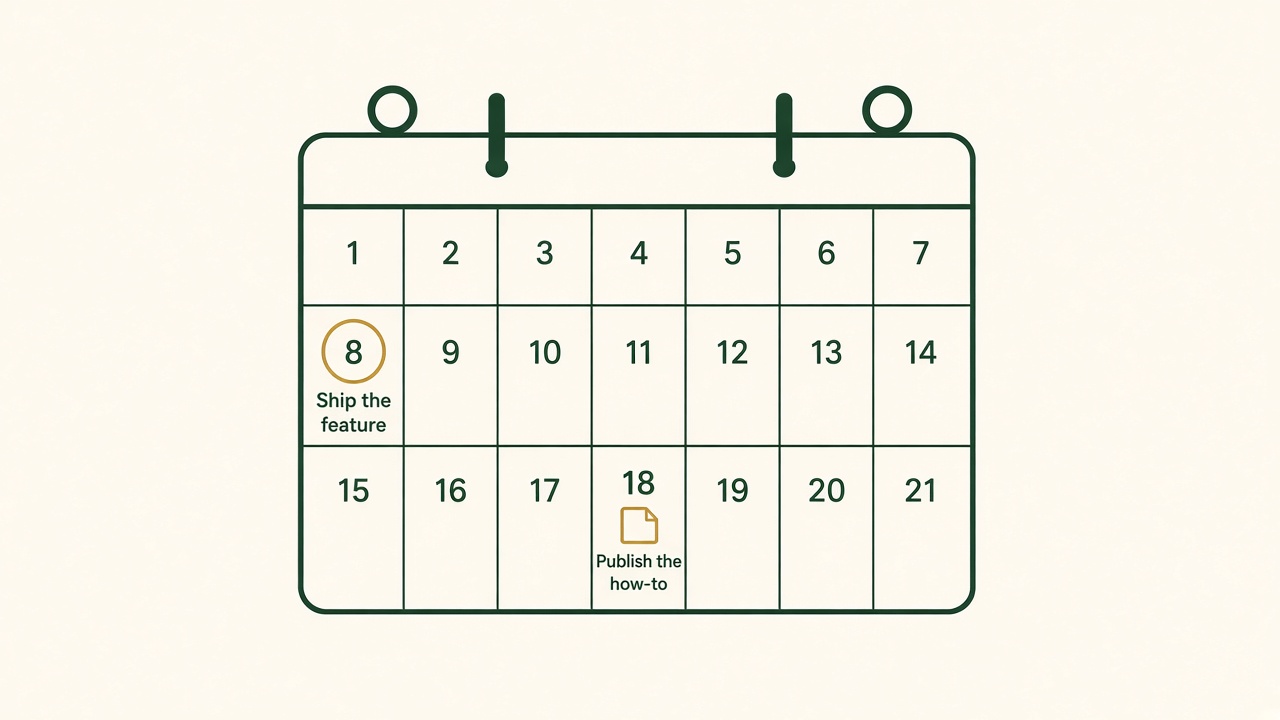
Ship the feature, then publish the how-to
The day numbers are not a schedule for any product. The point is that the tutorial waits until the screen customers will see is the screen in the article. A person still has to review it. That review is described in the AI content quality guide.
Two clocks fight at a launch. The product clock says the feature ships on a date, and the content should be ready when customers can use it. The publishing clock says a site looks abandoned if nothing new appears for months. You serve the product clock first. A how-to for an unshipped button is a liability. A quiet week while you fix the button is not a failed content strategy. Consistency means a cadence you can keep after launch, not a post on the morning the build slipped.
HubSpot’s content-plan guide suggests laying the calendar out four to six weeks ahead so production has room, mixing pieces that stay useful with pieces tied to a moment, and leaving space for something urgent. That is a planning horizon, not a volume target. For a founder who is also shipping the product, four to six weeks of outlines is realistic. Four to six weeks of finished, reviewed pages may not be. Put outlines on the calendar early. Put publish dates only on pages whose facts are already true in the product. When the release moves, the publish date moves with it. The calendar is a picture of the product timeline, not a promise to the internet.
How many blog posts SaaS companies publish is the question that tempts a fake average. I do not have a number that applies to your company, and I will not borrow one from a survey and call it a benchmark for startups. HubSpot’s article on blogging frequency is explicit that the range depends on the site. For a blog that is not yet a year old, they suggest aiming at several posts a month inside a few topic clusters, on the order of six to eight, if you are trying to build a body of work. For a complicated niche where each piece needs heavy research, they say to prefer fewer, on the order of two to four a month. They also say a small team without extra writers should not set a quota it cannot sustain, and should put the effort into pieces it can stand behind. Read that as their guidance for deciding a frequency, then apply the last clause harder than the first. A SaaS founder who can carefully review two tutorials a month should not publish eight because a mature media blog does. Eight unreviewed posts are not momentum. They are eight places for a wrong step.
The practical launch schedule is the trio, timed to the release. The explainer can be drafted before the date because the promise is stable. The how-to and the demo wait for the UI you will ship. The comparison can be drafted early and checked the day the behavior is final. After launch, the cadence is whatever review capacity remains once you are also answering customers. If that is one update a month to the how-to, that update is the strategy. A startup content plan that ignores support load will publish fiction about a product the founder no longer has time to open.
Do SaaS companies need a content strategist? They need the decisions a strategist would make: which questions, which pillar, which stage, which date, who reviews. At launch, the founder is usually the only person who can make them, because the founder knows what shipped. A strategist you hire before that list exists will invent topics to fill a retainer. Hire when the list is clear and the bottleneck is writing or reviewing at a quality you have already defined. The title is optional. The review is not. Nothing in the Vlozy & BloGoose for SaaS offer replaces that person. The offer does not include a strategist, a writer, or an editor. If you need one, they are yours to hire, and they should still use the same question list.
Budget-friendly tactics
A launch with a small budget still has three moves that do not require ads: repurpose the one fact, say something useful in a community that already has the problem, and write for another site only when you have a point that belongs there. Each one fails when it becomes a trick. Repurposing fails when the social caption invents a benefit. Community engagement fails when every reply is a link. Guest posting fails when the post exists to plant a keyword in an author bio.
Repurposing on a budget is the demo-and-guide pair you already planned, cut into the places your buyers scroll. The article is the durable page. The clip is the same moment, short, with burned-in words a person can read without sound. The text post, where a network does not take the video, repeats the sentence and links to the article. You do not script a second campaign. You do not pay for a new concept. You pay attention, once, to whether the words match. That is the whole saving. Teams blow the saving by hiring a separate social narrative that the product page cannot support. If the budget is small, refuse the second narrative.
Community engagement means answering the scheduling question where consultants already ask it, in the words of the thread, and linking the how-to only when the link is the longer version of the answer you just gave. A reply that is only a URL is an ad. A reply that explains how to set the hours, and then offers the page for the exceptions, is the same product-led idea in a smaller box. Spend time where you can be specific. Leave communities where you would have to pretend to be a customer. Founder-led marketing is recognizable. People can tell when the founder wrote the answer. They can also tell when a template did.
Guest blogging can be worth it when the other site’s readers have the problem and you are allowed to teach the job, not only to mention the product. It is a poor use of a launch week when you are still correcting your own how-to. Google’s spam policies treat large-scale guest posting whose purpose is keyword-rich links as link spam. Google’s reminder about large-scale article campaigns says the same thing more specifically: articles that inform another site’s readers are fine, and articles whose main intent is to build links are not. One careful article on a site your buyers read is a distribution choice. A campaign of posts written to move a ranking is the pattern those pages describe. If a publisher asks you to stuff the anchor, decline. The budget you save by not buying links is the point of this section. Spending it on a link scheme is not thrift.
Should a startup use paid or organic first? Organic is the default when the money is the constraint, because the page remains after the invoice stops. Paid placement can be the right first spend when you already have one true page and you need to learn, quickly, whether a specific group will click and try. In that case the ad points at the comparison or the how-to, not at a homepage that does not answer the question. Paid does not fix a missing pillar. It rents attention for a URL. If the URL is weak, you learn that faster and you also spend faster. I would not tell a founder with no reviewed pages to buy traffic. I would not tell a founder with a clear decision page that ads are forbidden. The order is the page, then the test. The content marketing analytics guide is where the test gets recorded, with UTM parameters and a key event, instead of a story about “brand awareness.”
Measure whether the launch content worked
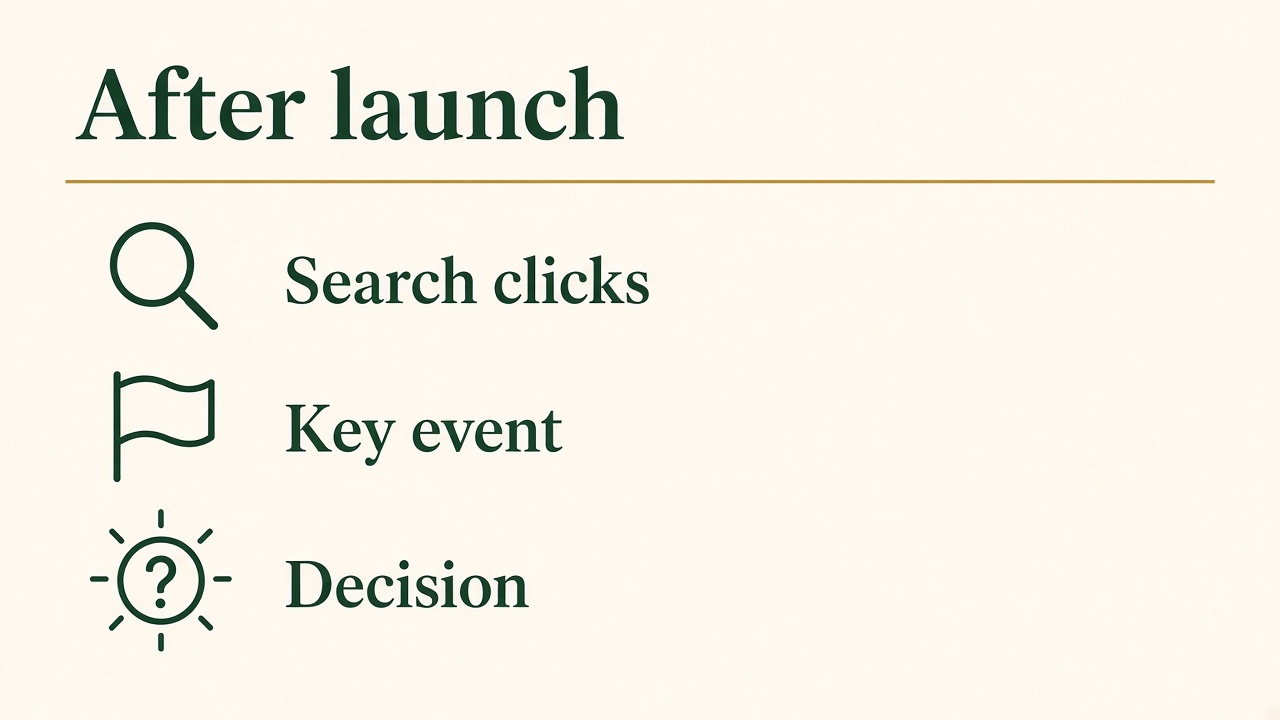
Search clicks, the key event, and one decision
The rows are empty because this page does not have a customer’s results. Fill them from Search Console and Analytics, using the method in the analytics guide.
A launch strategy that cannot be measured becomes a feeling about the week. The feeling is allowed. The report is separate. For each URL you meant to judge, you want to know whether Google Search showed it, whether people stayed long enough to count as engaged under GA4’s definition, and whether they took the next step you named. Shares and trial signups do not go in the same cell. The method is already written up as tracking what matters in content marketing analytics. Use that page for Search Console, GA4, UTMs, and the monthly table. This section only says what a SaaS launch should put in the table.
Name the key event before launch day. For the scheduling product it might be a test booking, a started trial, or a click from the comparison to the signup. Pick one. If you pick “time on page” as the success of a decision page, you will reward the longest comparison, not the one that helped someone choose. If you pick signups as the success of an awareness essay, you will call a useful explanation a failure because strangers did not buy on the first visit. Match the event to the funnel stage you wrote on the calendar. Awareness can be measured as qualified clicks into the comparison. Decision can be measured as the trial or the demo request. The how-to can be measured as the step you can see completed, if your product records it, or as the return visit to the next help page if it does not. Say which one you have. Do not upgrade a pageview into a product-qualified lead in the slide.
Give the launch its own campaign labels on the links you place off the site: the launch email, the community reply where a link belongs, the social caption. Source, medium, and campaign, spelled the same way in every asset. Then you can see whether the launch spike was search, the list you already had, or a post someone else wrote. Organic growth is the part that continues after those labels go quiet. Judge it on a later month, not on the Tuesday you announced. A single week of traffic is a spike. The strategy is working, in the only sense this page will claim, when the how-to still receives search clicks and the key event still occurs after you have stopped talking about the launch.
Use the numbers to edit, not to decorate a recap. If the comparison has impressions and no clicks, the title is not the question buyers type. If it has clicks and no key event, the page is not helping the choice, or the next step is unclear. If the how-to is used by customers and never found by strangers, it is a support asset, which is valuable, and it is not yet an acquisition asset. Fix the one gap. Do not respond to a quiet launch by publishing eight new topics. HubSpot’s frequency guidance already ties volume to review capacity. Your own analytics will tell you which of the three pillars is thin. Add there.
I will not add a target conversion rate or a required post count to this close. Those numbers would be mine, not yours. The launch worked as a content system if the three pillars are live, the demo matches the guide, the calendar moved when the product moved, and the monthly note can say what you will change. Customers are a business result on top of that system. Content does not owe you a quota of them. It owes the reader a true answer. Explore how the Growth Duo can jumpstart your content calendar if you want BloGoose drafts and Vlozy clips inside that system. You still choose the questions, and you still approve what ships.
Questions about a SaaS content launch
How do SaaS startups grow with content?
By answering a small set of real questions, showing the product inside the answer, and leaving those pages up so later readers can find them. Search and a key event tell you whether that is happening. Nothing in the approach guarantees a ranking, a trial, or a launch-week spike. A wrong page does not compound. A reviewed page can.
What content should I create for a new SaaS product?
A feature explainer, a how-to for the main job, and a comparison against the process people use now. Add one short demo of the same fact. Use the scheduling example as the shape: hours you set aside, a booking link, and the email thread it replaces. Skip any topic you cannot show in the product you are about to ship.
How many blog posts do SaaS companies publish?
There is no number that fits every company. HubSpot’s frequency article suggests more posts for a new site that can sustain them, fewer when the research is heavy, and a lower ambition for a small team without extra reviewers. Publish what you can fact-check against the product. Two accurate tutorials beat a quota copied from a large media blog.
Should a SaaS startup use paid or organic marketing first?
Build the page first. Organic content is what remains when spend stops, and it is the path that fits a tight budget. Paid media is a way to test a message against a page that already tells the truth. Do not buy traffic for a homepage that does not answer the buyer’s question. Do not treat ads as a moral failure if the URL and the key event are defined.
What is product-led content marketing?
Ahrefs defines it as content that helps the reader solve a problem using your product, with the product in the steps rather than in a hard sell. A how-to that uses your screens qualifies. A generic essay with a signup button at the end does not. Help articles, release notes, and landing pages are useful and are a different job.
Do SaaS companies need a content strategist?
They need the decisions: which questions, which pillar, which stage, who reviews, and what waits for the release. The founder can make those decisions at launch. Hire when the list is clear and the writing or the review is the bottleneck. A strategist does not replace product knowledge. The Growth Duo does not include one.
How do I target technical and non-technical audiences?
Give them different pages when they ask different questions. The consultant needs to know whether people can book only the hours they set. A technical buyer needs the behavior you actually ship, such as who can edit availability or how a time zone is handled. Write the technical page only after someone who knows that behavior has checked it. Link the two pages. Do not merge them into one essay that is vague for both.
The calendar starts from the questions, not from a quota. Explore how the Growth Duo can jumpstart your content calendar if you want drafts and short product clips as the production side of this plan. The measurement side is the analytics guide. Neither one chooses the use case for you.
Explore how the Growth Duo can jumpstart your content calendarYou still review the guide, the demo, and the claim before they represent the product.