
A practical guide
AI vs Human Content: Striking the Right Balance
I build software that can draft an article from a website and from notes a team maintains. I also read what I publish. Those two facts are the whole argument of this page. An AI draft can be fast. It is not finished, and it is not a person. The balance worth striking is a draft that saves the blank page, and a human review that decides what is true, what is yours, and what is allowed to represent the brand.
Marketing managers ask this as a fight: AI versus human writers. I do not think that fight is useful. A model can produce a lot of sentences. A person can tell whether the sentences describe the product you actually sell. Google has said the same thing in plainer policy language. Helpful, original pages can do well however they were produced. Pages made primarily to manipulate rankings, including piles of generated pages, are spam. Verthilix does not claim that AI alone yields citations or rankings. The questions on the homepage say the offer does not promise rankings, AI citations, leads, or sales.
This guide stays on quality, quantity, and the review in between. It is for people who are wary of letting a tool speak for the company, and who still do not want to type every first draft by hand. I will quote Jasper where Jasper has published the limit, and Google where Google has published the rule. I will not add a statistic about how much faster a team becomes. Speed without a reviewer is how a wrong sentence gets a URL.
The case for AI-generated drafts
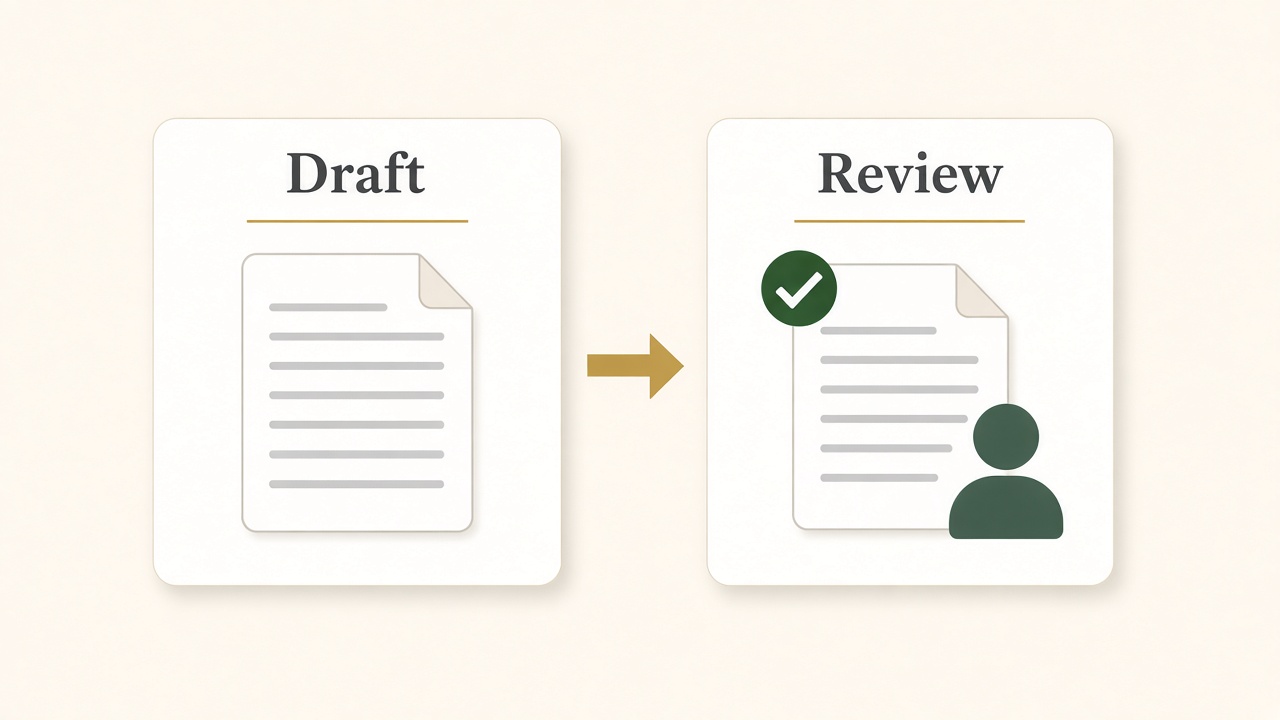
A draft, then a review
A tool can put a first version on the page. Publishing starts only after a person has checked it.
The case for a draft is ordinary. The blank page is slow, and a lot of business writing is a variation on a page you have already explained: what the product does, who it is for, what it does not do, and the question a customer typed. A model is good at laying sentences into that shape once you have given it the shape. It is bad at knowing which sentence is allowed to leave the building. Used that way, the tool is a production aid. Used as the author, it is a liability.
Jasper states the limit in its own description of AI content creation. On Jasper’s article on how AI content creation works, the company writes: “AI doesn't replace human judgment; it accelerates the production process so marketing teams can do more, faster, without sacrificing quality or brand consistency.” I am quoting that because it is the sentence people blur. Acceleration is the claim. Judgment is the part the sentence refuses to hand over. The same article says AI is a production accelerator, not a replacement, and that human writers still provide strategic direction, original thinking, real-world expertise, and editorial judgment. That is the case for drafts I am willing to repeat. It is not a case for unedited volume.
Volume is the temptation the sentence does not cancel by itself. “Do more, faster” is attractive when a calendar is empty and a competitor seems to publish every day. A calendar full of pages nobody checked is not the acceleration Jasper described, because quality and brand consistency were in the same sentence. If the second half is dropped, you are no longer following that advice. You are using the first half as a quota. I would rather publish fewer pages that a founder can defend than a month of posts that all sound plausible and one of which invents a feature.
Where a draft genuinely helps is the mechanical stretch of a piece you already understand. You know the reader. You know the source. You know the heading. The model can propose the opening, the order of the sections, and a plain-language version of a step you explained badly in a product note. You then replace what is wrong. That is faster than staring at a cursor, and it is slower than hitting publish. Both of those speeds are correct. The first speed is the point of the tool. The second speed is the point of the business.
Readability is part of this case and easy to fake. An AI draft is often readable in the narrow sense that the grammar is clean and the paragraphs are even. A marketing manager can skim it and feel relief. Readable for the customer is a different test. Can they tell what to do, what it costs, and what is not included, without reading the paragraph twice? Smooth prose that never lands on the product is readable and useless. I do not treat a readability score as approval. If a product shows one, it is a flag that a sentence is long or a heading is vague. The person still reads the page.
So the case for AI-generated drafts is a case for a starting point with a named job: get a structured draft onto the screen from material you supplied, so a person can spend their time on the parts that require judgment. It is not a case for replacing the writer, the editor, or the founder who has to answer for the sentence. Jasper’s wording already draws that line. I am holding the page to it.
Why human oversight remains crucial
Oversight is not a courtesy pass for tone. It is the only step that can notice a false fact, because the model does not know your product the way the person who ships it does. A draft can describe a limit you removed last month, a price you never charged, or an integration you have not built. It will do this in a confident paragraph. Grammar will not save you. The reviewer has to open the product, or the source note, and compare.
Brand voice fails in the same quiet way. A tool can be told “plain, specific, no hype” and still produce a paragraph that could sit on any vendor’s site. The sentences are inoffensive. They are not yours. A customer who has read your homepage can feel the swap even when they cannot name it. Human oversight is the person who deletes the generic benefit and puts back the sentence you would actually say in a support email. That person needs something to check against. A mood in someone’s head is not a standard. A written voice note is.
On BloGoose, that written standard is a set of eight editable context files. They are there so voice, style, keywords, SEO rules, and product information can be corrected by a person, not rediscovered by the model on every draft. I am not going to pretend the files review themselves. They are notes. If the product note is stale, every draft that reads it will be stale in the same way. Updating the file is oversight. Reading the draft against the file is oversight again. Skipping either one is how “we gave the tool our brand” becomes a sentence you do not recognize.
Accuracy and voice are the two failures I see managers worry about, and they are right to worry. There is a third. Accountability. When a page is wrong, someone has to correct it, answer the customer, and decide whether the error was a bad source or a bad edit. A model cannot be that someone. I put my name on pages I publish. That is the same duty described on the founder-led software page. The Growth Duo for AI-assisted content asks you to review what goes live, and the offer does not include a writer, an editor, or an account manager who will do that review for you. That is a product boundary, not a slogan. If you need another person in the chair, hire them. The software will still hand you a draft. It will not take the blame.
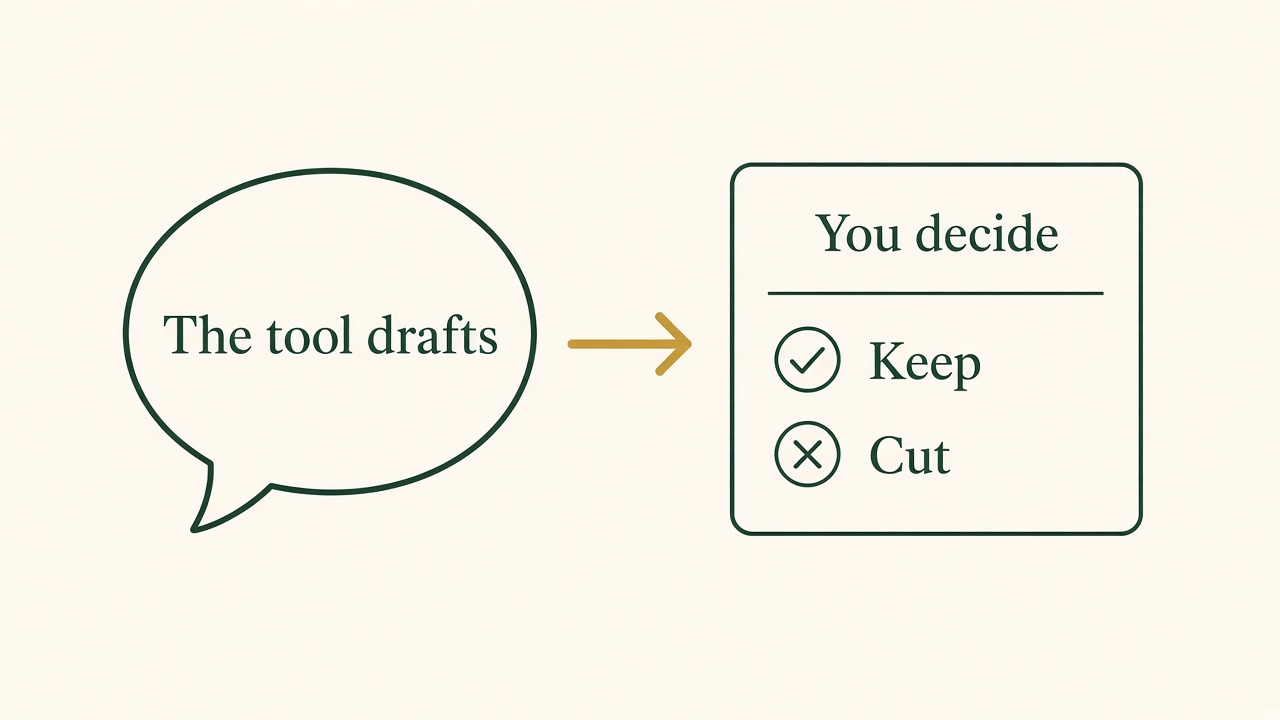
The tool drafts. You decide.
Keep the sentence that matches the source. Cut the one that does not. The draft does not make that choice.
Jasper’s editing guidance makes the same split from the toolmaker’s side. Its article on editing AI content says the most successful strategies treat AI as a collaborative tool rather than a replacement for human creativity and expertise, and that human judgment, creativity, and expertise remain essential. The edit it describes is concrete: brand voice across channels, accurate and current information, value beyond a surface summary, and a connection to the audience you actually have. I cite that as a checklist of reasons a person stays in the loop, not as a reason to buy any particular writer product. The loop is the point. The brand of the drafting tool is not.
“Does BloGoose use human review?” is the question that usually follows, and I am going to answer it without inventing a department. You review the draft before it represents you. I review what I publish under my own name. The product can research, draft, and show scores. A score is not a signature. I will not describe a hidden editor inside the tool, because that editor is not what the offer includes. The human in the loop is the human who owns the page.
Quality guidelines for AI content
Quality is a set of checks you can fail, not a feeling that the draft “looks fine.” I use the same five checks on my own pages and on drafts I would ask a customer to make. They are the AI Draft Quality Checklist later on this page. The three that need the most explanation are facts, originality, and tone, because each one has a fashionable shortcut that does not work.
Checking facts and biases
A fact-check is an open tab, not a vibe. For every claim that a customer might rely on, you should be able to point at the page, the product screen, or the note that says it. Prices, limits, dates, “we do not do this,” and the names of features are the claims that hurt when they are wrong. Google’s guidance on generative AI content is direct about why the check cannot be skipped: generative models do not retrieve facts, they predict a likely sequence of words, and the output can be inaccurate. Google says it is critical to manually fact-check and review all AI-generated content before publishing, and that the review includes metadata, structured data, and the text on images. A title that promises a feature the body does not have is still a false claim. It is also the line a search result may show.
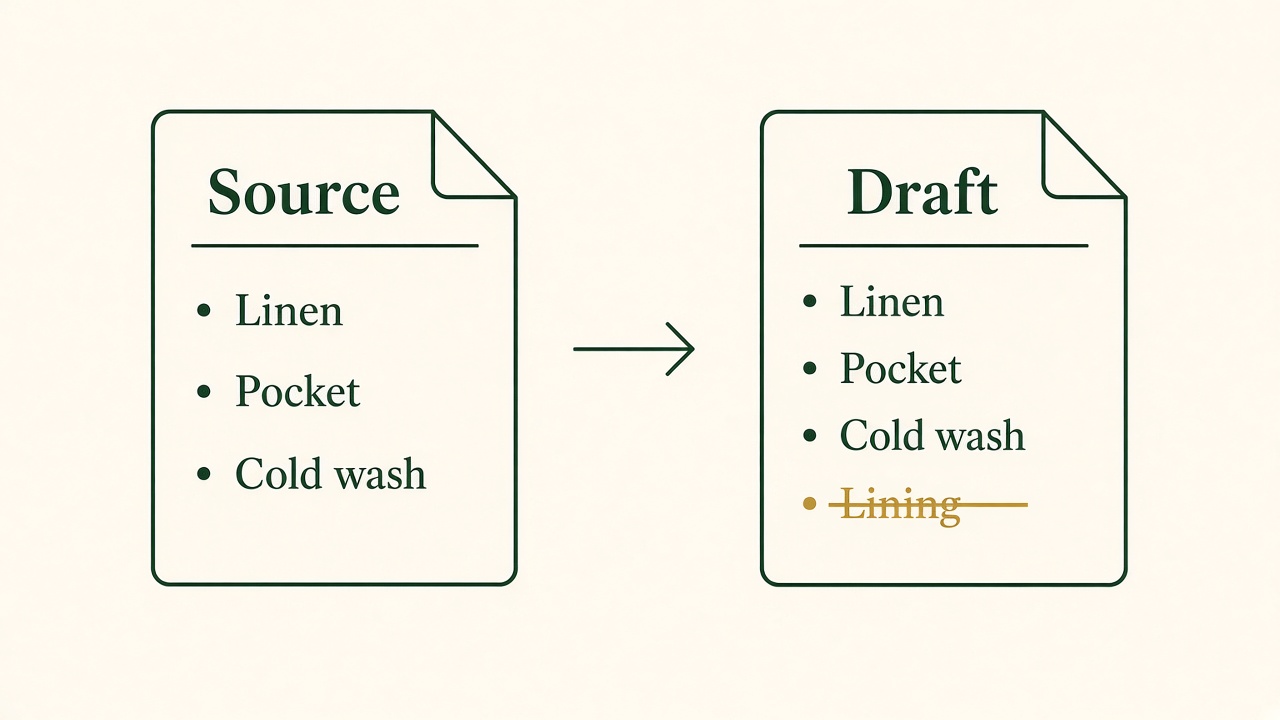
Delete the fact the source does not contain
The shirt details are an example, not a Verthilix product. If the source never said lining, the draft does not get to add it.
Bias, in this work, is not a political detector you paste onto the draft. It is a draft that argues one side because that side was common in the text it learned from, or that omits the limit because limits are less common than benefits. A product page that only lists gains is biased in the way that creates refunds. The fix is to put the condition next to the claim: who it is for, what is excluded, what the person still has to do. If the source notes do not contain the condition, the model must not invent a flattering one. Leave the sentence out until a person supplies it.
I also treat “studies show” and “most teams” as unfinished until the study or the team is named. An AI draft loves a floating authority. If you cannot open it, delete it. That rule has saved me from repeating numbers I did not measure. It will save a marketing manager from a sentence a journalist, or a customer, can puncture in one reply. The fact-check is done when a skeptical colleague can follow each load-bearing sentence to a source without asking you to remember where it came from.
Ensuring originality
Originality is not a percentage from a plagiarism tool, and it is not “the model wrote it, so it is new.” A draft can be original in the sense that the sentences have never appeared before, and still be a restatement of three articles with the nouns swapped. It can also be a close copy of a page you fed it, or of a page already on your site. Google’s spam policies name the abusive version: stitching or combining content from other pages without adding value, scraping and lightly transforming it, and generating many pages that do not help anyone. A plagiarism check is worth running because it catches the obvious copy. It does not catch the polite rewrite that adds nothing. A person who knows the sources has to read for that.
The practical check has two comparisons. First, set the draft next to the sources you allowed. If a paragraph tracks another article’s order and examples, rewrite it from your own product or cut it. Second, set the draft next to the pages you already published. If this URL repeats an article you have, do not publish a twin. Add the new fact to the existing page or do not write it. Duplicate pages are an originality failure even when no other company is involved. A tool that “spins” a post into ten near-copies is manufacturing that failure on purpose.
Run the plagiarism check on the draft you intend to publish, not on an earlier version you then heavily edit without checking again. Tell the reviewer what the check cannot see: ideas, structure, and unattributed paraphrases. If a passage needs someone else’s wording, quote it, link it, and keep the quote short. The rest of the page should be the explanation only you are in a position to give, because you build the product or you did the work. That is the originality Google’s people-first questions are pointing at when they ask whether you are mainly summarizing others without adding much.
Maintaining brand tone
Tone is a decision you write down, then enforce in the edit. “Professional but friendly” is not a decision. “Say what the product does in the first two sentences. Do not promise a ranking. Name the limit. Use ‘I’ when Roktim is speaking and ‘you’ for the reader” is a decision. Those lines belong in the brand notes the draft is built from, and in the review. The longer version of that file is the brand voice and compliance guide. Keywords belong there too, as the words customers use, not as a list to repeat until a score moves. If the note says the product is software and not an agency, the draft does not get to say a team of strategists will handle the campaign.
The edit for tone is usually deletion. AI drafts add a framing sentence, a summary sentence, and a sentence that tells the reader the topic is important. Your brand may not talk that way. Cut them. Then read the page aloud. If you would not say it to a customer on a call, it is not your tone yet, even if it is polite. Jasper’s editing article treats this as part of keeping a voice consistent across channels. I treat it as part of not embarrassing the product. A blog post, a help article, and a social caption can differ in length. They should not differ on what is true or on whether the company sounds like itself.
Keywords are a tone problem when they take over the sentence. A brand note can list the phrases you are willing to be found for. The draft should use them where they are the natural name of the thing. Stuffing the phrase into every heading is how a page stops sounding like the company and starts sounding like a file written for a robot. The reviewer who owns the voice is allowed to choose the clearer sentence over the exact keyword. Search systems are better at understanding a clear page than a contorted one, and the customer is the person you can lose in the first paragraph.
Google’s stance on AI content
Google’s public position is older than the current wave of writing tools, and it has been restated in plain language. In Google’s post on AI-generated content, the company says using automation, including AI, to generate content with the primary purpose of manipulating rankings violates its spam policies. It also says not all automation is spam. Appropriate use of AI is not against the guidelines. Using AI does not give content special gains. If a page is useful, original, and satisfies aspects of what Google calls E-E-A-T, it might do well. If it does not, it might not. That is the whole penalty question. There is no separate punishment for “a human used a tool.” There is a spam policy for using the tool, or a room full of people, to manufacture rankings.
E-E-A-T is experience, expertise, authoritativeness, and trust. It is not a badge you add to an AI draft, and it is not a score the model can award itself. Google’s guide to helpful, people-first content says the reason you publish should be to help a person who lands on the page, and that using automation to manipulate rankings is a spam violation. The same guide asks whether automation, including AI generation, is evident to visitors when they would reasonably wonder how the page was made, and whether you explain why the tool was useful. Disclosure is a reader-service question, not a magic ranking switch. On a page where a tool drafted and a person corrected, I would rather say that than leave a reader guessing. I would not add a disclosure and then skip the correction.
The scaled-content rule is the quantity side of the same stance. Google’s spam policies define scaled content abuse as many pages generated for the primary purpose of manipulating rankings and not helping users. The examples include using generative AI tools to generate many pages without adding value, scraping and lightly rewriting, stitching pages together, and making many pages that make little sense but contain keywords. The policy applies no matter how the pages were created. A human content mill and an unattended model can violate it in the same way. “We edited with AI” is not a defense if the purpose of the pile is rankings. “We drafted with AI and a person added the product knowledge” can be fine if each page helps someone and would have been worth writing anyway. Search Engine Journal reported a later comment from Google’s Gary Illyes that the useful word is not “human created.” It is “human curated”: someone had editorial oversight and checked that the page was correct. A label that says “reviewed” is not that check.
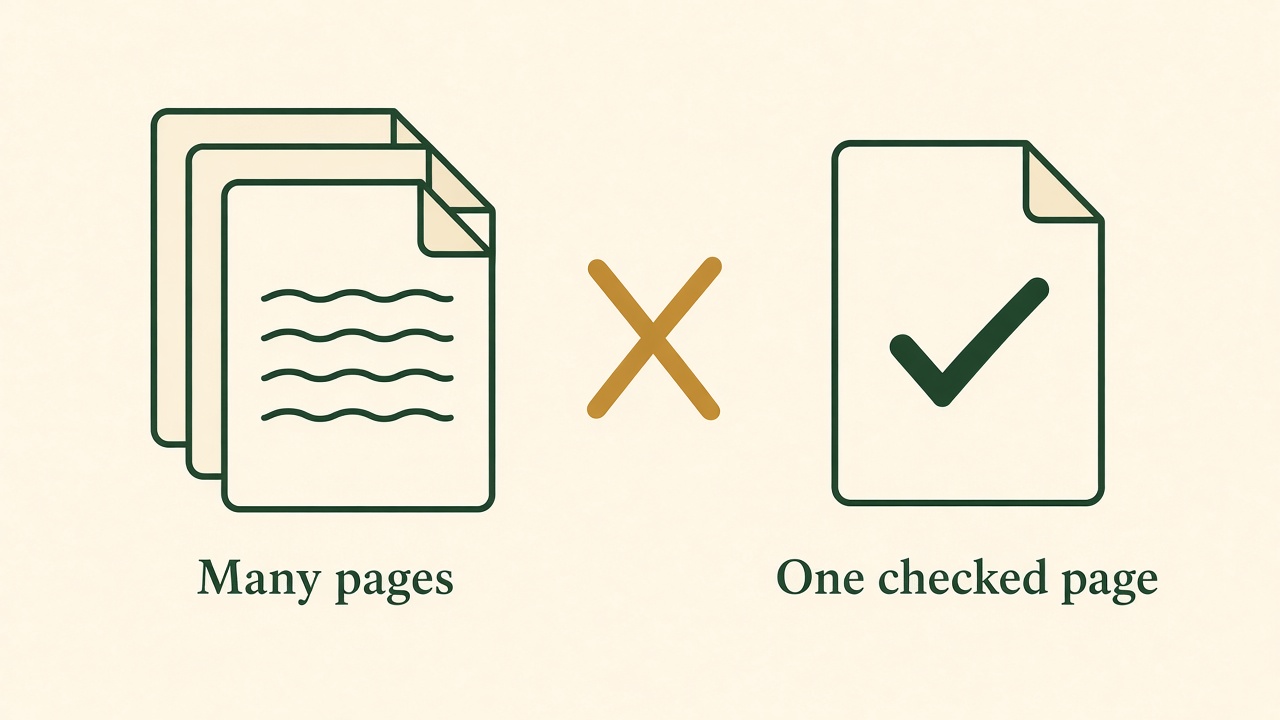
Many unchecked pages, or one checked page
Google’s spam policies cover piles of pages made to manipulate rankings, including piles made with generative tools. One page a person has checked is a different object.
Can AI content rank? Google’s own words allow it, and they refuse a bonus for it. I will not turn that into a forecast for your site. Rankings are an outcome of Google’s systems, the page, the competition, and things neither of us controls. What I can say, because the homepage already says it, is that useful pages can become eligible to be found, and that rankings and citations are not part of the sale. Anyone who tells you an AI workflow includes a place in Google’s results is selling something Google has not offered.
The risks of an AI-written article follow from those documents, not from a horror story. The draft can be factually wrong. It can be a summary of other people’s posts. It can be one of hundreds of thin URLs. It can sound like a brand you do not run. It can be readable enough that nobody notices until a customer does. None of those risks is solved by a longer prompt. They are solved by the review Google already told site owners to do, and by refusing to publish at a volume you cannot check.
Productivity versus precision
Productivity and precision pull in opposite directions only if you measure productivity as published URLs. Measured as finished, defensible pages per month, they are the same goal. A draft accelerates the part before judgment. Precision is the judgment. If you cut the second to inflate the first, you did not become more productive. You moved unreviewed text into public, where the correction is slower and more visible.
A workable balance is a cap you set from review capacity, not from the tool’s speed. If one careful person can truly edit four substantial articles in a week, four is the number. The model can propose eight. You still publish four, or you add a second reviewer who is allowed to say no. The unused drafts are not a backlog of assets. They are text that has not been checked. Leaving them in a folder is fine. Scheduling them is not. This is the opposite of a content calendar that treats every generated title as a promise to the internet.
Precision has a floor, and the floor is the checklist. A page does not go out because the calendar square is red. It goes out because the facts match a source, the page is not a copy, the tone matches the notes, and a person signed it. Some drafts will fail and be thrown away. That is a successful use of the tool. You learned the angle was thin before you gave it a URL. Teams that cannot bear to discard a draft will publish the failure in order to feel the generation was worth the subscription. The subscription is worth it when the discarded draft saves a wrong page, not when every generation becomes a post.
How much editing does the draft need? As much as it takes for you to be willing to put a name on it. I will not give you a percentage, because a clean draft of a page you know well may need a few corrections, and a fluent draft of a page you do not know may need to be rewritten from the sources. “Light edit” is a dangerous instruction to give a junior reviewer. Tell them what they are responsible for: every number, every product claim, every sentence that cites an authority, and the decision to cut what is generic. A comma pass is not that job. Google’s instruction to fact-check all of it is closer to the right size of the work.
Should you hire writers if you use an AI tool? Hire them if the review is more work than you can do, or if the subject needs experience you do not have. Do not hire them to rubber-stamp a queue, and do not skip hiring them on the theory that the model is the writer. The Verthilix offer is explicit that a writer and an editor are not included. That is so a buyer does not think the subscription is an agency. If your team has no one who can check a product claim, the honest next step is a person, not a larger prompt. The tool can still draft once that person exists. It should not be the reason you decided you did not need them.
The balance I want for Verthilix is visible. Software does the repetitive drafting. A person does the precision. The offer page is where the commercial line is drawn, including what is not included. This article is where the editorial line is drawn. If they ever disagree, the offer page wins and this article should be corrected. I would rather under-publish than ship a page that makes the product sound like something I do not sell.
From an AI draft to a published page
The workflow is short on purpose. Extra stages are where unreviewed text hides. Four moves are enough: decide the page, draft it from sources, edit it against the checklist, and publish only the approved version. A diagram of that is an ordered list, because the order is the control. You do not publish from the draft step. You do not edit before you know which sources are allowed.
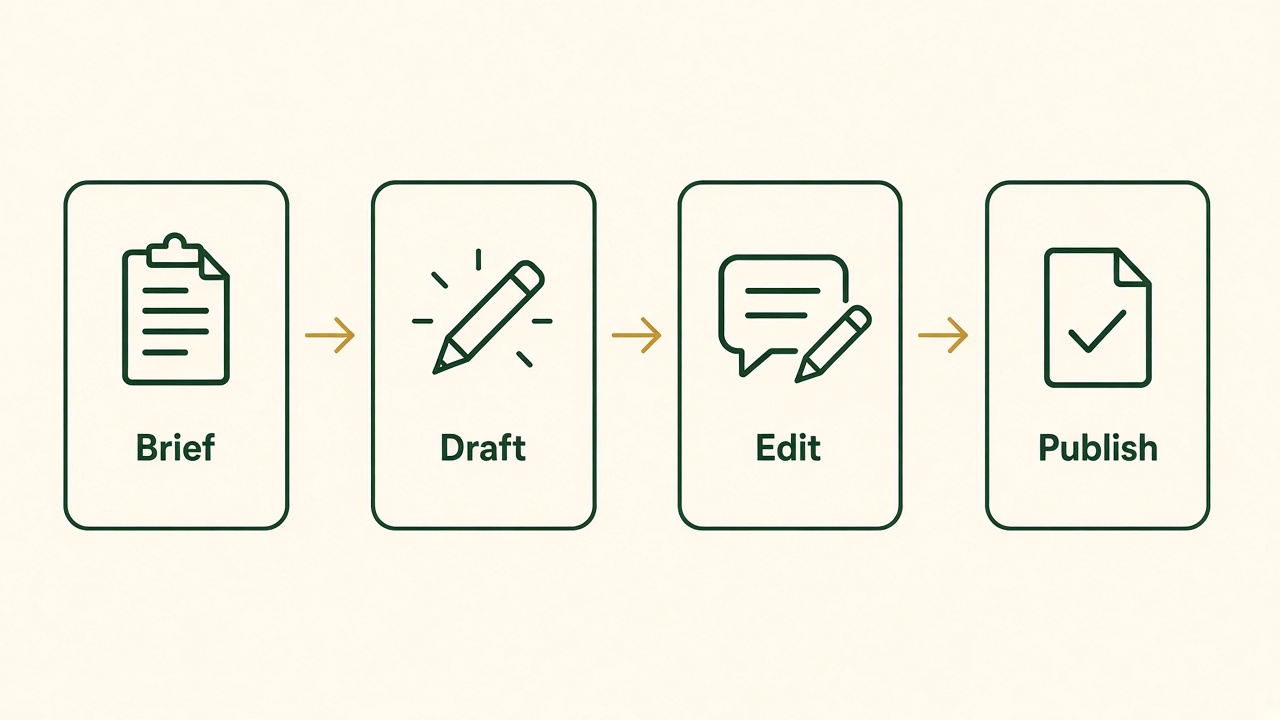
Brief, draft, edit, then publish
The sources are chosen first. The tool drafts second. A named person edits third. Only the approved version is published.
- 1. Brief Name the reader, the question, the sources a person may use, and the product facts that are off limits to invent. Point the draft at the brand notes.
- 2. Draft Let the tool propose the article from that material. Treat the output as a draft, including the title, the meta description, and any text on an image.
- 3. Edit A named person runs the checklist: facts, bias and borrowed arguments, originality, brand tone, and a full read. Failed sections are rewritten or cut.
- 4. Publish The approved page goes live. The draft, the sources, and the reviewer’s name stay with it so a later correction has somewhere to start.
AI Draft Quality Checklist
- Every product claim, number, and date matches a source you can open.
- Nothing important was invented, and the limits sit next to the claims.
- The draft is not a close rewrite of a source, or a twin of a page you already published.
- The voice matches the written brand notes, including what you refuse to promise.
- A named person has read the full page and would put their name on it.
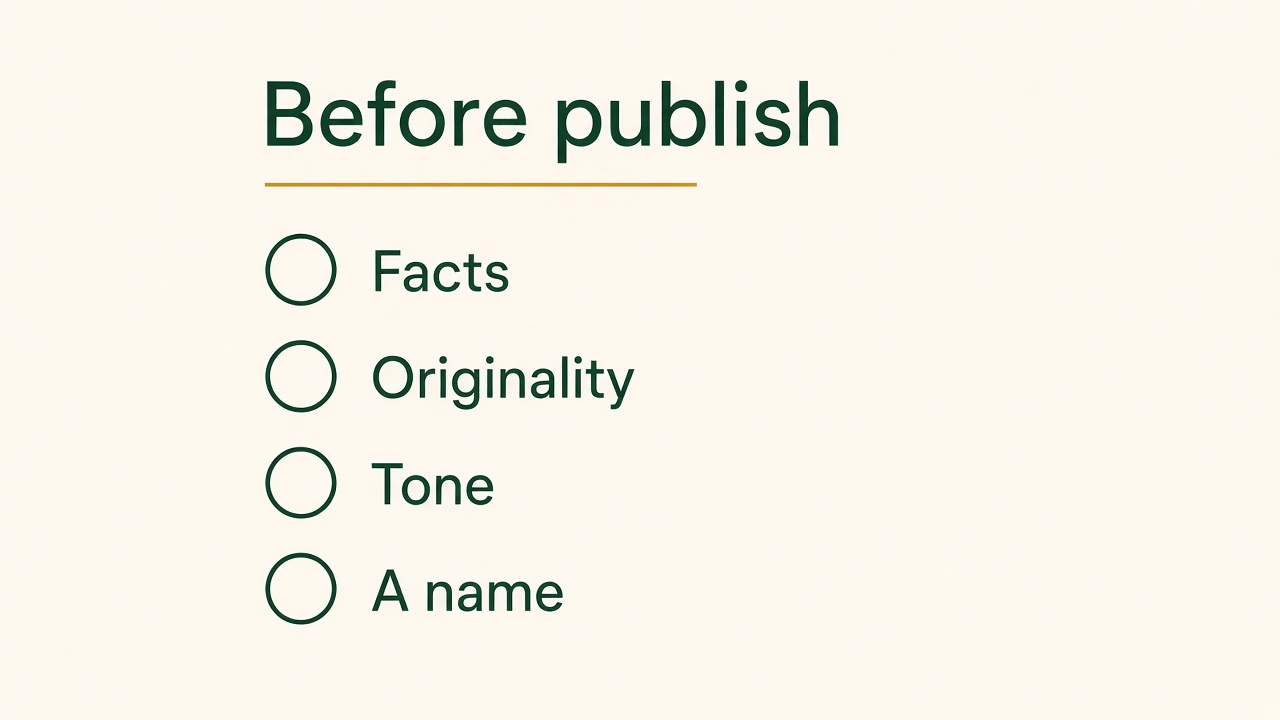
Facts, originality, tone, and a name
The drawing is the short form of the list above. The circles are empty because the check is still yours to make.
The brief is where most bad AI pages are actually decided. “Write a blog post about our product” gives the model permission to choose the audience, the promise, and the facts. A brief that says who is reading, what question they asked, which URLs may be used, and which claims are forbidden takes that permission back. You can still let the tool suggest an outline. You do not let it suggest a new product. If the brief and the context files disagree, fix the files or the brief before you generate. A draft built on a contradiction will average them into something you did not mean.
The draft step should be allowed to be imperfect. That is what the next step is for. What it should not be allowed to do is publish itself on a timer. Scheduling is a convenience after approval, not a way to get the approval done while you sleep. If your stack can post the moment generation finishes, turn that off until the checklist is a required gate. I would rather a post be a day late than a day wrong.
The edit step is where “how much editing” becomes visible. Mark the sentences you changed and why, at least until the reviewer trusts their own habit. A fact change is mandatory. A tone change is mandatory when the sentence is not something you would say. A structure change is mandatory when the draft answered a different question than the brief. A wording change that only makes the paragraph sound busier is optional, and often worse. Keep a copy of the sources beside the draft so the fact-check is a comparison, not a memory test. If you run a plagiarism comparison, do it on this edited text, then read the passages the tool did not flag.
Publishing includes the boring fields. Google asked for the metadata to be reviewed because the title and description can appear in results even when the body was fixed. Read them. Read the image text. Read the author line. If the page used a tool for the draft, decide whether a reader would reasonably ask how it was made, and say so in a sentence if they would. Then stop. A published page is not a prompt you keep regenerating because a score twitched. Correct it when a fact changes or a sentence is wrong. Do not regenerate it weekly to look fresh. Google’s helpful-content questions call out date changes that do not reflect a real update.
This is also the workflow I want associated with BloGoose. Try BloGoose drafts, then edit them. The product can help you research and draft from the site and from those context files, and it can show you scores. You still approve the final post. If the draft fails the checklist, it does not get a workaround in the form of a louder prompt. It gets an edit or a no.
The future: human and AI collaboration
The durable version of this work is not a new job title for the model. It is a division that stays stable while the tools change. The tool proposes language from the material you provided. The person supplies experience, checks expertise against the product, and lends the page whatever authority and trust the company has earned. E-E-A-T does not transfer from a vendor’s model to your URL. It is built by the pages you stand behind and by the corrections you make when you were wrong. Founder review is my version of that. I can see the product, I can say no, and my name is on the site. A larger team can split the same duties. It cannot delete them.
Collaboration gets worse if the human job is redefined as “accept or reject the whole draft” with no time to open a source. That is a rubber stamp with extra steps. Collaboration gets better when the person is expected to change the draft, and is judged on the published page rather than on how many generations they approved. Jasper’s line about judgment remaining essential is a prediction I am comfortable with, because the failure mode of these tools is still a confident sentence that was not true. Faster models do not remove that failure. They shorten the time between the error and the URL, which makes the reviewer more important, not less.
I expect the labels to keep moving. Teams will be sold “autonomous” publishing, brand agents, and scores that claim to measure quality. Some of those will be useful drafts. None of them are a reason to retire the checklist. Google’s documents, as they stand, still tell you to fact-check generative output, still withhold a special gain for AI, and still treat mass low-value pages as spam however they were made. When a product pitch contradicts those documents, believe the documents. When a pitch contradicts the limit on the Verthilix offer, believe the offer. AI does not, by itself, yield a citation, a ranking, or a finished article.
The future I will build toward is narrower than the category. A founder or a marketer keeps written notes about the product and the voice. A tool drafts from those notes and from sources a person chose. A person edits. The page goes out with a name on it. If that sounds unfashionable next to a promise of hands-free content, it is also the only version I can reconcile with Google’s rules and with the way I want Verthilix to sound. Learn how BloGoose drafts can accelerate your writing (and you still approve the final post). If you want the subscription that pairs that drafting with the rest of the offer, read the Growth Duo for AI-assisted content and decide from the terms, not from this essay.
Questions about AI content quality
Is AI-generated content readable?
It is often grammatically smooth. That is not the same as readable for your customer. A readable page lets a specific person find the fact, the limit, and the next step without searching again. Even paragraph lengths and a friendly tone can still hide a missing answer. Read the draft as the customer. Do not stop at a score.
Does Google penalize AI-written text?
Not as a class. Google says appropriate use of AI is allowed, and that using automation primarily to manipulate rankings is spam. Scaled content abuse includes many low-value pages made with generative tools when the point is rankings rather than users. A useful page that a tool helped draft is not, by that fact alone, a violation. A pile of unreviewed pages can be.
How do I ensure quality in AI content?
Use the checklist on this page. Match every load-bearing claim to a source, cut invented or one-sided claims, compare the draft with its sources and with your existing pages, match the brand notes, and have a named person approve it. Review the title, description, and image text too. Google says generative output can be wrong and must be checked before it is published.
Should I hire writers if I use AI tools?
Hire a person when you need experience or review time you do not have. The tool does not employ that person for you. The Verthilix offer does not include a writer or an editor. If nobody on the team can check a product fact, fix that before you scale drafts. A hired reviewer who only clicks approve is not the hire this page is describing.
What does E-E-A-T mean for AI content?
Experience, expertise, authoritativeness, and trust. Google points site owners at those qualities when it talks about helpful content. A model does not possess your experience. The reviewer who knows the product, cites real sources, and is accountable for corrections is how a page earns them. Adding the letters to a footer does nothing.
Can AI content rank on Google?
It might, if it is useful and original, and it might not. Google says there is no special gain for using AI. It also says content made to manipulate rankings can violate spam policies. I do not sell a ranking, and the homepage says citations are not part of the offer. Eligibility to be found is not a promise of a position.
What are the risks of AI-written articles?
False product facts, copied or stitched material, a voice that is not yours, and a large set of thin pages. The technical reason is the one Google gives: the model predicts likely words and can be inaccurate. The business reason is that customers believe the page. Review is how you keep those risks off the site.
How much editing does AI content need?
As much as it takes for a named person to stand behind every claim. There is no reliable percentage of the draft you can skip. A familiar topic may need a short correction. An unfamiliar one may need to be rebuilt from the sources. A polish that leaves a wrong fact in place is not enough editing.
Does BloGoose use human review?
You do. The draft is for you to edit and approve before it is public. The offer does not include a writer or an editor who performs that approval. I am not going to invent an extra review layer inside the product. Scores can point at a weak spot. They are not the signature.
Learn how BloGoose drafts can accelerate your writing (and you still approve the final post). The commercial terms, including what is not included, are on the Growth Duo for AI-assisted content.
Learn how BloGoose drafts can accelerate your writingYou still approve the final post. The draft is not the approval.