
A practical guide
Generative Search Optimization (GEO): Preparing for AI Search
I build Verthilix founder-led tools for founders and teams who need to communicate clearly and publish work they can stand behind. This page is about Generative Search Optimization, the name people use when a search result is written by a model instead of only listed as a link. I do not sell GEO as a service, and I do not promise that Google, ChatGPT, or any other system will cite your site.
The useful question is narrower. When a search product writes an answer, which of your existing habits still matter, which new files are unnecessary, and how do you tell a real public document from a tactic invented to sell a tool? Google has published that baseline. So have long-standing marketing and search publications. This guide stays inside those sources and inside the difference between classic rankings, answer-focused work, and generative summaries.
If you already read the guide to Answer Engine Optimization, treat this page as the next distinction, not a repeat. AEO is about being usable when a system answers a question. GEO is about the generative layer: an AI Overview, a chatbot reply, or another written synthesis that may draw on more than one page and may not link to you at all.
Defining GEO
Generative Search Optimization is the practice of preparing a website for search experiences that generate language. The result is not only a title and a URL. It can be a paragraph that mixes several sources, a follow-up answer in a chat box, or a short overview shown above the familiar list of links. People abbreviate that practice as GEO. Google does not publish a product by that name. The abbreviation is industry language for a shift Google describes in its own documentation as generative AI features in Search.
The shift is easy to overstate. A generated paragraph does not replace the index. For Google, a page still has to be found, crawled, and indexed before it can be a supporting link in AI Overviews or AI Mode. Google’s documentation on AI features and your website says there are no additional technical requirements beyond being eligible to appear in Search with a snippet. You do not add a special machine-readable file. You do not add a special schema.org type whose only job is “GEO.” If the page is blocked, snippet-limited by accident, or full of text that exists only inside an image, the generative layer has less to use. That is ordinary Search eligibility, not a new gate.
GEO also has to be separated from the chat products people mention in the same breath. A person can ask ChatGPT, or a similar assistant, to explain a topic. That product may answer from earlier training, from a browsing or retrieval step, or from a mix. It can describe your subject without displaying your page. It can also show a link when a live lookup finds you. “Can ChatGPT display my website’s content?” therefore has no single yes. Display is a feature of that product’s current mode, not a right you earn by adding a keyword. I mention ChatGPT here only as the example people ask about. I do not offer a setup that targets it, and I do not claim a mention is included with any software I sell.
A knowledge graph and a generated answer are different objects. A knowledge panel is a structured box of facts Google has associated with an entity. A generative answer is prose. You can be in one and absent from the other. Treating “get into the knowledge graph” and “get quoted by a model” as the same project produces pages that are stuffed with unattributed facts and still fail both tests. GEO, as I use the term, is about the prose layer: whether your page is a clear, original, checkable source if a system writes from the open web.
Search Engine Land’s practical writing on AI search visibility makes the same starting point Google does. Its guide to being visible in AI Overviews, chatbots, and LLMs points readers back to helpful, reliable, people-first content, and then to the technical conditions that let a crawler reach the page: crawlable architecture, a sitemap, and structured data that matches a real page rather than a trick. I cite that as a publisher’s checklist, not as a ranking formula. Where it and Google differ in emphasis, I say so later, especially on schema.
The definition I want you to keep is short. GEO is preparing pages for generated search answers by doing the public, durable work: unique useful writing, visible facts, a crawlable site, and no attempt to manufacture citations. It is an evolving label. It is not a file format, and it is not a guarantee.
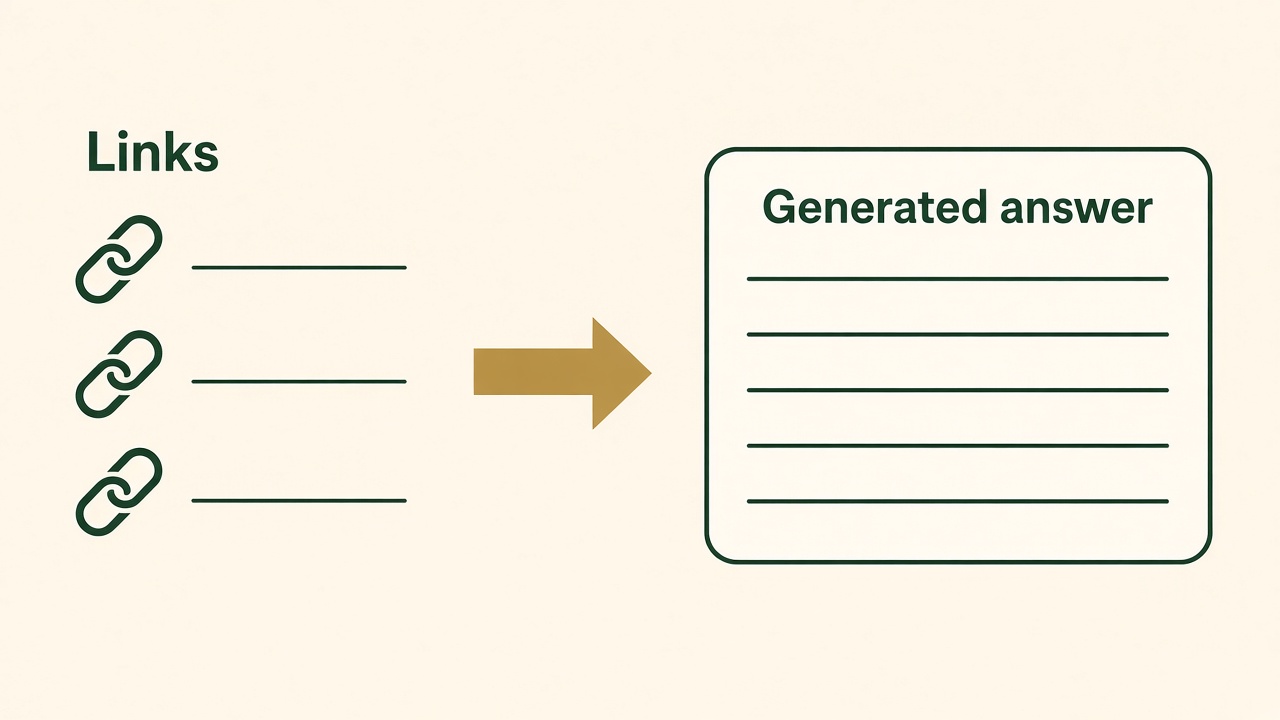
Links beside a generated answer
A generative result is written language. It can sit next to links, and it can also appear without naming your page. The lines in the card are blank on purpose.
GEO vs SEO vs AEO
Three labels are now crowded into the same meetings. They are not synonyms. Mixing them is how a team buys the wrong work. Classic SEO is about earning a place in a list of results for a query. Answer Engine Optimization is about being usable when the result is a direct answer, including spoken and question-shaped queries. Generative Search Optimization is about the written synthesis: an AI Overview or a chatbot answer that may combine sources and may not send the click you used to count.
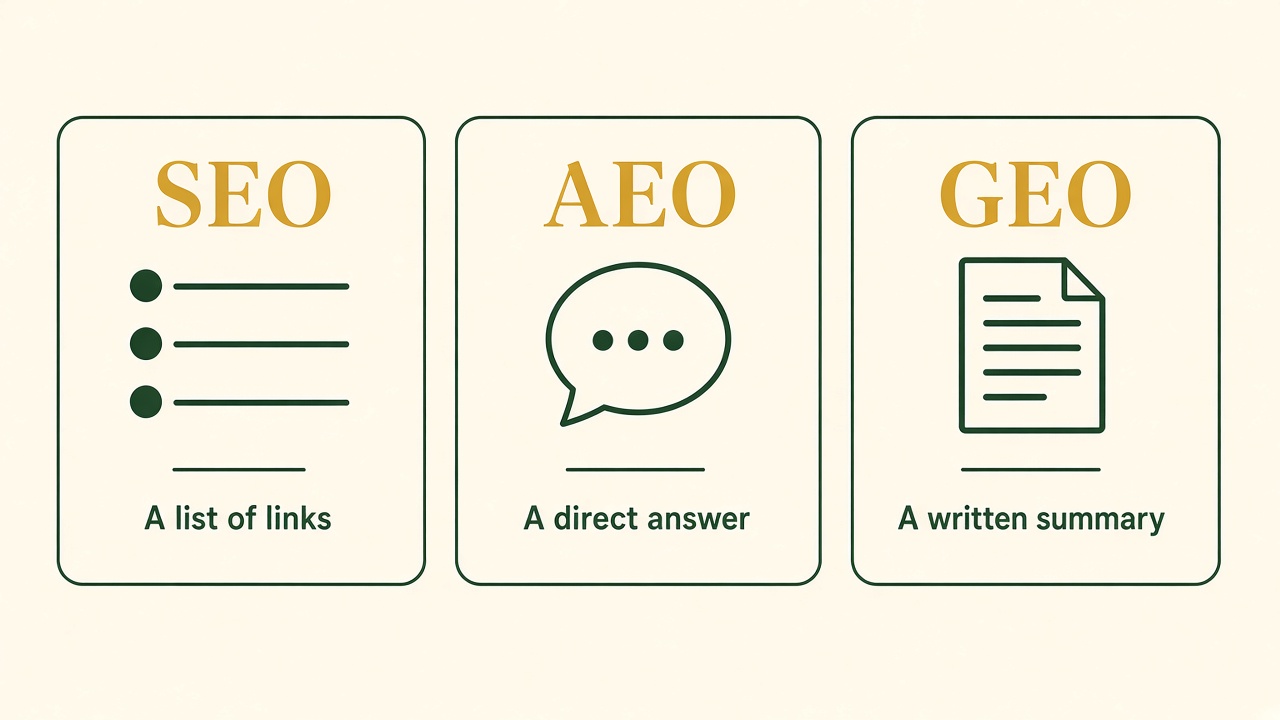
SEO, AEO, and GEO are different jobs
SEO is a list of links. AEO is a direct answer a system can use. GEO is a written summary that may blend sources. GEO here is not geography.
| Label | What it focuses on | What success is not |
|---|---|---|
| SEO | Crawling, indexing, understanding, and ranking links for queries. | A promise that a generated paragraph will name you. |
| AEO | Question-shaped and voice-style answers a system can use without distorting the fact. | A special schema file that replaces the article. |
| GEO | Generated summaries and chat-style search that may blend sources. | A guarantee of an AI citation, or a new technical requirement Google has not published. |
How AI ranking differs from SEO is mostly a difference in the object you are looking at. SEO performance is still visible as impressions, average position, and clicks. A generative result can answer the query on the results page and change whether a click happens. Some questions will lose the visit because the overview was enough. Others will still send a person who wants the full page. You have to read your own reports rather than treat “AI ranking” as a separate score.
AEO and GEO overlap, and they should. Both care about a clear answer. The Answer Engine Optimization guide stays on the question-and-answer habit: headings that match the question, sentences that stay true if lifted, and voice queries. This GEO page stays on the generative system around that answer: how an overview is assembled, why a chat product may never fetch your URL, and why multiplying near-duplicate pages does not make a model more likely to prefer you. If a sentence fits both pages, I would rather send you to the page whose job is that sentence than paste the same essay twice.
Canonical tags sit in the SEO column even when the worry is an AI answer. If three URLs carry the same explanation, Google’s guidance on consolidating duplicate URLs still applies. A canonical, a redirect, or a single preferred URL tells Google which address you want used. Generative features do not invent a second canon. Search Console’s generative AI report assigns impression data to the canonical URL, not to a duplicate. If an overview links to a parameter URL or an old copy, the fix is the same duplicate cleanup you would do for ordinary Search. Splitting one GEO article into ten URLs that differ only by the word “ChatGPT,” “Gemini,” or “Copilot” makes that cleanup harder and matches the scaled-content pattern Google warns against.
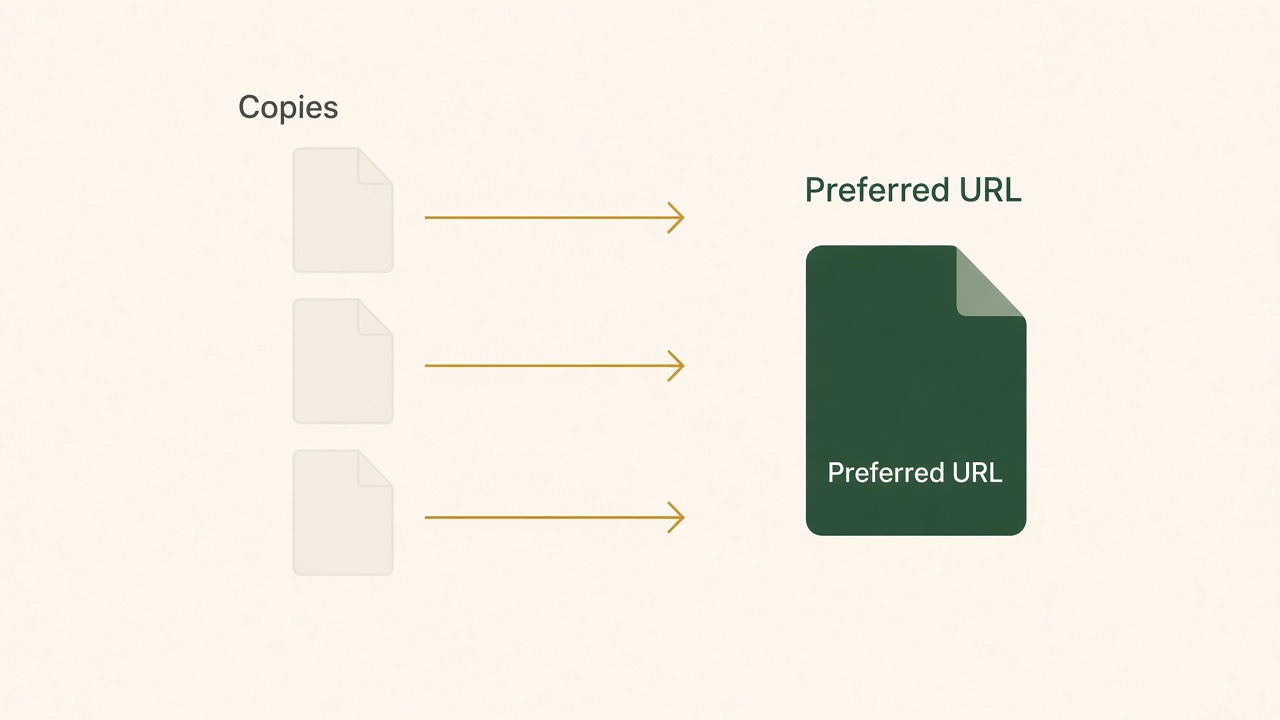
Several copies, one preferred URL
Redirects and a canonical tell Google which address you want used. Generative results do not create a second preferred URL.
Long-tail keywords matter as evidence of how people ask, not as a production quota. A founder searching “how do Google AI Overviews work for a small SaaS site” deserves a page that answers the mechanism and the limit. They do not deserve twenty pages that swap the product category and keep the same paragraphs. Google’s generative guide says its systems can judge relevance even when the query and the page’s main heading are not an exact match. Exact-match proliferation is an old SEO habit. It is a worse habit when the stated goal is to influence generated answers.
How Google’s AI Overviews work
AI Overviews are a Google Search feature that can show an AI-written summary together with links to pages a person can open. AI Mode is a related experience for longer, more conversational searching. Google groups them as AI features. The public rules are in the AI features document, not in a private GEO specification.
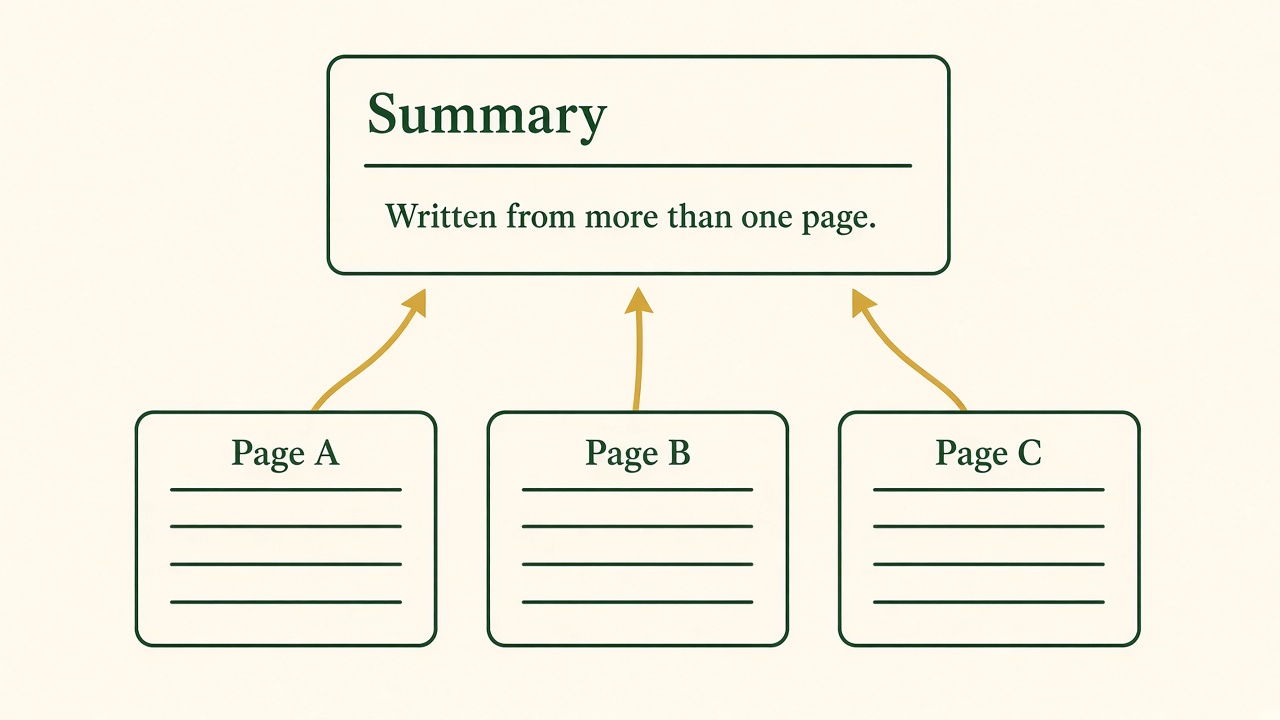
A summary written from more than one page
An overview can draw on several sources. Your URL can be one of those links, or none of them. The page names here are placeholders, not citations.
Eligibility is ordinary. The page must be indexed. It must be eligible to be shown with a snippet. Crawling must be allowed in robots.txt and by the host. The page should return a success status. Important content should be available as text, not only as text baked into an image. Internal links should make the page findable. Merchant Center and Business Profile details should be current when the query is commercial or local. Google lists those as the worthwhile fundamentals. It then says specific optimization is not required for AI Overviews and AI Mode, and that there is no additional technical requirement.
That sentence answers “how to optimize for AI Overviews” more honestly than a 40-point checklist. You optimize by being a normal, strong Search result: crawlable, indexed, snippet-eligible, and worth opening. You do not optimize by adding an undocumented token, a hidden prompt, or a file named for a model. Google says you do not need new machine-readable files, AI text files, or markup to appear in these features.
The overview is not a featured snippet with a new coat of paint, even though both can show text above the links. A featured snippet is a selected extract. An overview is generated and can draw on more than one source. Your page can contribute a supporting link without contributing the sentence the reader remembers. It can also be unused while a competitor with a clearer first-hand account is linked. You will not see a line in Search Console that says “lost overview to this URL.” You will see whether you are indexed and which queries still show your pages.
Preview controls are part of how the feature works, not an afterthought. nosnippet, data-nosnippet, max-snippet, and noindex limit what can be shown. Google notes that more restrictive permissions limit how content is featured in AI experiences as well as in classic listings. If a template from an old SEO plugin sets a strict snippet length on every URL, you may have opted out of the very surface you are trying to understand. Check the live HTML before you rewrite the prose.
Speed of update is the question people ask next, and Google does not give a clock. “How fast do AI search results update?” has no published interval for Overviews. A correction on your page becomes available to Google after recrawl and reindexing, on the same general machinery as any other change. A chat assistant that is not retrieving the live page can keep an older description until its own product updates. If a customer quotes a stale sentence, the responsible move is to fix your page and, if you control the other channel, correct it there. You cannot push a refresh button inside someone else’s model.
Google’s guide to optimizing for generative AI features adds the editorial half of the mechanism. The systems look across sources. A unique viewpoint is more useful than a restatement. A first-hand review is different from a summary of other people’s posts. Commodity listicles add little. The guide also says there is no ideal page length, no need to break pages into tiny chunks for the model, and no need to rewrite in a special style just for generative search. AI systems can understand multiple topics on one page and show the relevant piece. That is the mechanism I am willing to repeat, because it is the one Google wrote down. The same guide says to measure that visibility in Search Console, and to ignore third-party tools that claim access to Google’s internal ranking or AI metrics.
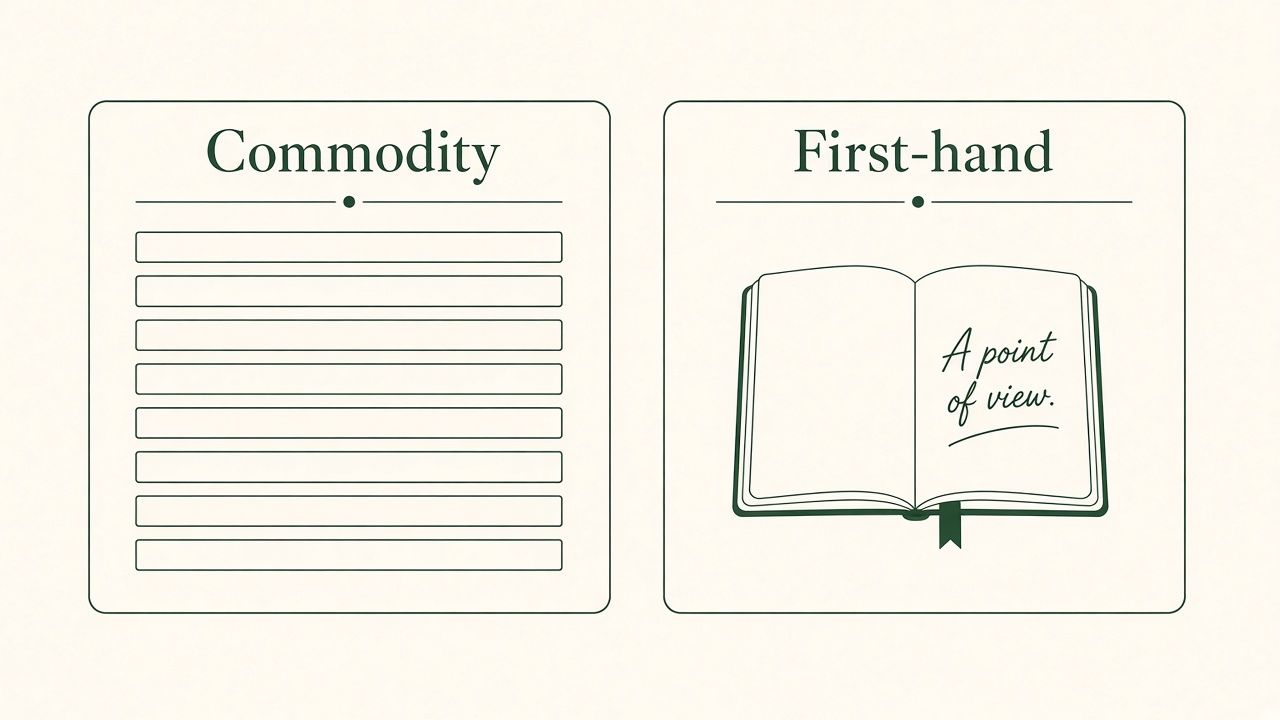
A list anyone could write, or a point of view
Google’s generative guide contrasts commodity pages with work that brings experience. The notebook is the second kind. It is not a ranking badge.
Optimizing content for AI search
Optimization here means making the page a good source, not steering a model. Three habits do most of the work: say the fact in a structure a person can follow, attach the fact to a source the reader can open, and phrase the page so a follow-up question is answered without a new URL.
Clarity and structure
Clarity is a sentence that survives being lifted. “GEO means adding a secret file so ChatGPT recommends you” is clear and false. “GEO means preparing a page for generated search answers, with no promise of a citation” is clear and usable. Put that kind of sentence under the heading that matches the question. Follow it with the condition. If the truth is “it depends,” name the dependency in the next line: whether the experience retrieves the live web, whether the page is indexed, and whether you have allowed a snippet.
Structure is headings, paragraphs, and a visible order. Google’s generative guide says people appreciate pages organized into sections with headings, and that you should write for the human audience. It also says you do not have to chunk the page into fragments for the AI to understand it. A tight section for each real question is enough. A page smashed into one-sentence blocks so a scraper can eat it is harder for a person and is not a documented requirement.
Concise facts still help. Prices, limits, dates, and “we do not do this” belong in prose, not only in a graphic. If the only correct statement of your plan is inside an image, a text-based overview cannot quote it fairly. Pair the fact with the date when the fact expires. An overview that repeats last year’s limit is then your editorial problem to correct, not a mystery of “the algorithm.”
Schema belongs under structure only when it describes the visible page. Google’s structured data policies require the markup to match what users can see. FAQ markup on this page repeats questions that are written below. It does not add claims. Google’s AI features page says there is no special schema you need to add for AI Overviews or AI Mode. Practitioner guides, including Search Engine Land’s, still recommend FAQ or HowTo markup for classic rich results and for making a page understandable. Both statements can be true: markup can help ordinary Search features, and it is not a GEO ticket. Invisible questions that exist only in JSON-LD fail the match test.
Authority and references
Authority in this context is not a score you paste into a footer. It is whether a careful reader can see who is speaking, why they know, and which public document supports a technical claim. On this page I am Roktim Saha. I build software. I am not an agency selling GEO retainers. When I describe how AI Overviews treat eligibility, I link Google’s page so you can check the wording. When I describe how marketers are talking about the shift, I link HubSpot or Search Engine Land rather than invent a statistic.
Google’s people-first standard is the right test for that kind of reference. Creating helpful, reliable, people-first content asks who created the page, whether it shows first-hand knowledge, and whether the reader would need to search again. It also asks whether automation, including AI generation, is disclosed when a visitor would reasonably wonder how the page was made. A page that cites a real Google document and then adds a founder’s limit (“I will not promise a citation”) is doing that job. A page that cites “studies show” and never names the study is not.
E-E-A-T is the same idea in Google’s ranking language: experience, expertise, authoritativeness, and trust. Google’s post on AI-generated content says ranking systems aim to reward original, high-quality content that demonstrates those qualities, however the content was produced. Appropriate use of AI is not against the guidelines. Using automation primarily to manipulate rankings is spam. Using AI does not give content special gains. If the page is useful, original, and trustworthy, it might do well. If it is not, it might not. That is the penalty question, answered without a special “AI penalty” beyond the spam policy that already existed for automated content.
References should be pages a technical marketer already trusts, used for a specific claim. I use Google for eligibility and spam rules, Search Engine Land for the practitioner checklist around crawlability and people-first writing, and HubSpot when the point is how a large marketing organization describes the change in search. I do not use them as decoration. If a sentence does not need a source, it should be something I am willing to own as the person who builds Verthilix.
Conversational framing
Conversational framing means the page can answer the next question a person would ask out loud. After “what is GEO?” they ask whether AI ranking replaces SEO, whether a chatbot can show their site, whether Google punishes AI writing, and whether long-tail pages are still worth making. Those questions are the outline of this article. They are also how chat-style search is actually used: a first question, then a narrower one.
Google has said that in AI search experiences people ask longer and more specific questions, and they ask follow-ups. You serve that pattern by staying on the page and answering the follow-up under a heading, not by opening a new thin URL for each follow-up. A Q&A rhythm is appropriate. A fake dialogue that hides the fact is not. Write the question as a person asks it. Answer in prose. Stop when the limit is clear.
Should you use AI to optimize for ChatGPT? You can use a writing tool to help draft, outline, or edit a page you understand. Google allows that when the result is helpful and not made to game rankings. You should not use a tool to spin dozens of pages whose only purpose is to be mentioned by a chatbot. That is the manipulation case in the AI-content guidance. It is also a poor use of a founder’s time. I would rather you plan and draft articles that answer real customer questions, then read them before they are public, than aim a generator at a model’s name.
Conversational pages still need a point of view. The generative guide’s example is the difference between “seven tips for first-time buyers,” which anyone could write, and a first-hand account with a specific consequence. For software, the equivalent is “here is what I will not claim” rather than “seven ways to dominate AI search.” The refusal is information. It tells a buyer what the Growth Duo plan details are not: they are not an AI-citation package.
Role of site health and E-E-A-T
Site health is the set of conditions that let a search system reach the page and let a person use it. Robots rules must allow crawling. The URL must work. Internal links should connect the explanation to the rest of the site. The main text should be text. Images and video can support the point, and Google’s AI features notes say high-quality images and video give more ways for a page to be useful, including when someone searches with a picture. They do not replace the paragraph that states the fact.
Page experience still counts because a generated answer that links to a broken or hostile page wastes the click Google is trying to make more useful. The succeeding-in-AI-search note says even strong content disappoints people if the page is cluttered, slow, or hides the main information. Latency, mobile layout, and a visible distinction between the article and the chrome are part of GEO only because they are part of Search. There is no separate speed score for overviews.
E-E-A-T is how Google talks about whether the page deserves trust. Experience is first-hand contact with the subject. Expertise is knowing the mechanism well enough to state the limit. Authoritativeness is being a source others can check, which on a small site means naming the author and linking to primary documents rather than pretending to be a committee. Trust is not over-claiming. For me, trust on this topic is the sentence I repeat: useful pages can become eligible, and eligibility is not a citation.
A founder-led site has a specific version of that trust. Verthilix founder-led tools are built by one person, in India, for people who want software rather than a faceless content mill. That identity should match across the homepage, this guide, and the offer. If this page said a team of GEO analysts would get you into AI answers, the site would be lying about who does the work. E-E-A-T is not a badge in the footer. It is whether the byline, the offer, and the article describe the same business.
Site health includes not competing with yourself. If the AEO guide and this GEO guide repeated the same 2,000 words, neither would be the preferred source. The canonical and the internal link exist so a person, and Google, can see which URL owns which distinction. Keep titles, headings, and the first answer aligned with that job. Do not point a canonical at a different article just to “consolidate GEO.” Consolidation is for duplicates, not for neighboring topics.
Spam policies are the boundary of E-E-A-T, not a separate religion. Scaled pages, scraped summaries, and expired domains used to host generated text are the patterns Google already fights. GEO advice that tells you to publish hundreds of AI pages “for coverage” is advice to walk into that boundary. The people-first guide asks whether you are producing lots of content on many topics in the hope that some of it performs, and whether you are summarizing others without adding much. If the answer is yes, the page is not ready, no matter which acronym you put in the title.
Monitoring AI presence
There is no native view that prints every generated sentence that used your site. There is a native view of impressions. Google’s Search Console help for the generative AI performance report says the report shows how often links to your site were shown in AI Overviews and AI Mode, grouped by page, country, device, and date. Page data is assigned to the canonical URL, the same way the ordinary performance report works. It does not show the wording of the answer. Use that report, and the indexing report, before you adopt a third-party “AI visibility score.” Google’s optimization guide says no third-party tool has access to Google’s internal ranking or AI systems. If the page is not indexed, it is not eligible to be a supporting link. That single check still ends a lot of GEO anxiety. The broader habit of reading these reports without inventing a return is in the content marketing analytics guide.
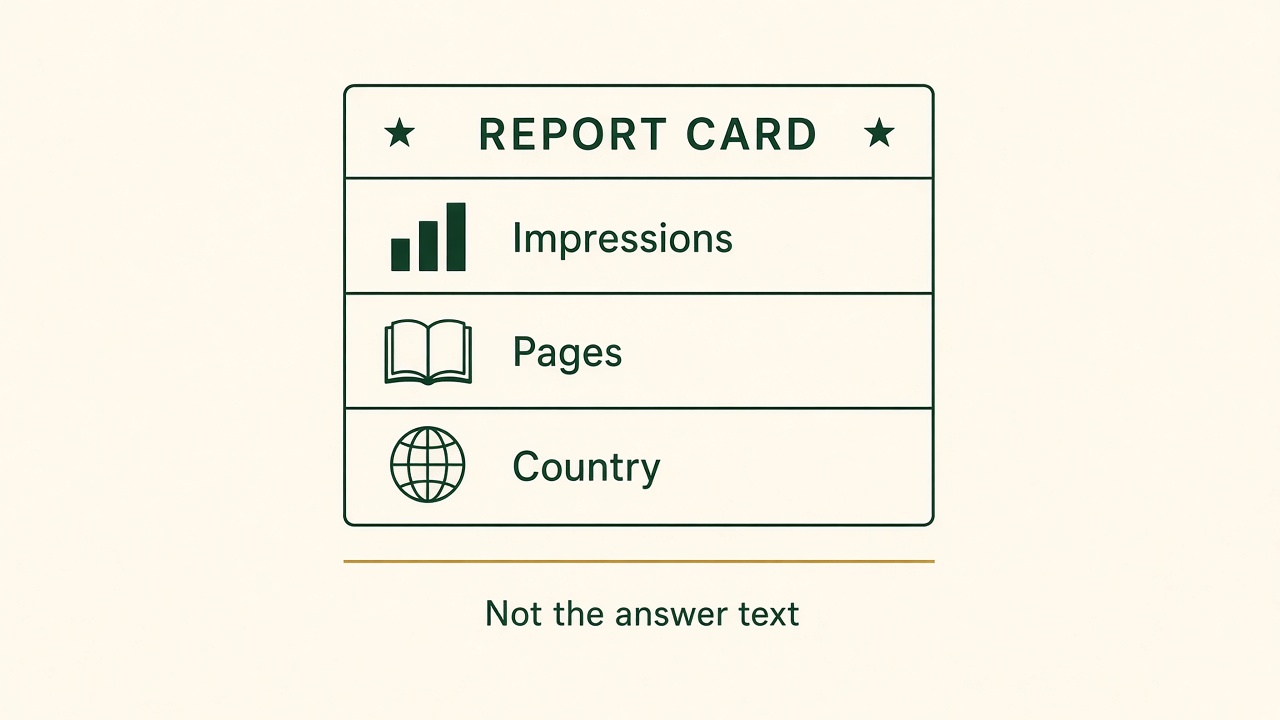
Impressions, pages, and country. Not the sentence.
Search Console can show that a link appeared in an AI Overview or in AI Mode. It does not hand you the paragraph the reader saw.
Manual tests are the second instrument. Ask the question in Google. Record the date, whether an overview appeared, whether your URL was a supporting link, and the sentence that would mislead a buyer if it were wrong. Ask a follow-up. Repeat after you change the page, knowing that recrawl is not instant. Do the same, separately, in a chat product if your buyers use one. Write down whether that product was browsing. A screenshot without the date and the product mode is not a measurement.
Search trends and query reports tell you which long questions are real. They do not tell you to mint a URL per question. Cluster the follow-ups under the page that already answers the parent question, unless the follow-up needs different evidence, a different product fact, or a different decision. “Will AI answers hurt my traffic?” belongs here, as a monitored question, not as a new site section. Watch branded queries and the queries you targeted. If impressions rise and clicks fall on a question an overview can fully answer, that is data about that query. It is not proof that GEO “failed” or that you must publish more pages.
HubSpot’s public discussion of search AI is useful as a description of what marketing teams are trying to watch: whether they are recommended inside generated answers, whether snippets are scannable, and whether authority signals exist. It is not a measurement API. I would not pay for a report that cannot show its method. I would pay attention, for free, to indexing and to a dated log of the queries that matter to the business.
Software can help you produce and review the page you decided to monitor. It cannot certify that a model saw it. When I point to planning and drafting articles, I mean the human job of choosing a question, gathering sources, and approving the draft. An SEO score inside a product is a checklist. It is not a generative ranking. If a dashboard claims otherwise, ask for the query, the date, and the raw answer. If those three are missing, you are looking at a label, not a measurement.
Future outlook
Generative answers are already part of major search products, and the labels will keep moving. Google ships AI Overviews and AI Mode and then writes guides that tell site owners the fundamentals did not change. Other products fold chat into the search box. Bing’s chat-style search, and the assistants built on similar models, will keep changing their browsing behavior. A GEO page that depends on one button label will be stale. A GEO page that depends on crawlability, original writing, and honest limits will still be readable after the label changes.
The likely pressure on founders is commercial, not technical. More agencies will sell “GEO” as if it were a channel with a rate card. More tools will offer a score. The public documents from Google will continue to say that unique people-first content matters more than tactics, that there is no required special file, and that scaled pages aimed at manipulation are spam. When a pitch contradicts those documents, believe the documents. I would rather lose a fashionable project than ship a claim my own FAQ would have to retract.
For a small team, the sensible outlook is a short list. Keep the important pages indexed and snippet-eligible. Answer the real questions in text, with the author’s name and the date. Link to primary sources when the claim is about how a search product works. Do not split one idea across a swarm of URLs. Review anything a model drafted before it represents the product. The standard for that review is the AI content quality guide: facts, originality, and a person who will sign the page. Measure indexing, clicks, and generative AI impressions. Sample the overviews that matter. Ignore promises of citations.
That outlook matches how I want Verthilix founder-led tools to be understood. The software can help you make the article or the video. You still decide what is true. The Growth Duo plan details are the place to see what the subscription includes and what it refuses to promise. This guide is the place to see how I think about generative search. If the two ever disagree, the offer page and the product facts win, and this article should be corrected.
I will update this page when Google’s own guides change a rule I have stated, or when a sentence here would mislead someone about the software. I will not update it every time a vendor renames a tactic. GEO is evolving. The durable part is already written down by the search engines and can be checked.
GEO questions
What is Generative Search Optimization (GEO)?
It is the practice of preparing a site for search experiences that write an answer, such as Google AI Overviews, rather than only ranking links. It still depends on crawling, indexing, and useful pages. It is not a promise that a model will cite you, and it is not a service I sell.
How does AI ranking differ from SEO?
Classic SEO is visible as links, impressions, and clicks. Generative results can summarize sources on the results page and change whether a click happens. Google says the same fundamentals still apply and that there is no extra technical requirement for AI Overviews or AI Mode. “AI ranking” is not a separate system you can buy your way into.
Can ChatGPT display my website’s content?
It might, if the product is retrieving live pages and chooses to show a link. It might also answer from earlier training without opening your URL. You cannot require a mention, and a chat reply is not proof that your page was read. I mention ChatGPT only because people ask. I do not optimize for it as a channel.
How do Google AI Overviews work?
They can show an AI-written summary with supporting links. A page must be indexed and eligible to appear with a snippet. Google says there are no additional technical requirements, no required AI text file, and no special schema you must add for this feature.
Does Google penalize AI-generated content?
Not as a class. Google says automation, including AI, is acceptable when it helps create useful content. It is spam when the primary purpose is to manipulate rankings. AI use does not grant a special boost. The page is judged as a page, including whether it shows experience, expertise, authoritativeness, and trust.
How do I optimize for AI Overviews?
Stay eligible for ordinary Search: allow crawling, keep the page indexed, put important facts in text, and match any structured data to the visible content. Write something a person would not get from a generic summary. Google says there is no ideal length and no need to rewrite the page in a special style just for generative features.
What is the role of canonical tags with AI search?
They still identify the URL you want used when duplicate or near-duplicate pages exist. Generative results do not add a new canonical system. Clean duplicates with redirects or canonicals as Google’s duplicate-URL guidance describes. Do not create extra URLs just to have more generative “coverage.”
Do long-tail keywords matter with AI answers?
People ask longer questions and follow-ups, so the language of real questions matters. Google also says its systems can understand relevance without an exact match. A separate thin page for every long-tail variant, published mainly to influence AI answers, is the scaled-content pattern to avoid. Answer the follow-up on the page that already owns the topic.
How fast do AI search results update?
Google does not publish a fixed refresh time for AI Overviews. Your corrected page becomes usable after it is recrawled and reindexed. A chat product that is not looking at the live URL can stay on older material until that product changes. There is no button that pushes your edit into someone else’s model.
Should I use AI to optimize for ChatGPT?
Use a writing tool only if you will stand behind the finished page. Do not use it to mass-produce pages aimed at chatbot mentions. Google treats automation whose primary purpose is ranking manipulation as spam. I do not sell a workflow whose goal is a ChatGPT citation.
Will AI answers hurt my traffic?
They can remove a click when the overview answers the question, and they can still send a person who wants the rest of the page. Use Search Console’s generative AI performance report for impressions in AI Overviews and AI Mode, and do not assume one outcome for the whole site. That report does not show the answer text.
This page is the explanation. If you want help planning articles that answer customer questions, and you will still review them, you can plan and draft articles in BloGoose. If you want the commercial terms, read the Growth Duo plan details. Neither page is an offer to place you inside an AI answer.
Read the Growth Duo plan detailsThe offer page is where included software, review duties, and limits are stated.