
A practical guide
Maintaining Brand Voice & Compliance in AI-Generated Content
A brand voice is the set of sentences you are willing to say in public. Compliance is the set of sentences you are allowed to say. An AI draft can sound like the first and still break the second, or follow a rule sheet and still sound like nobody who works there. Keeping both is a writing problem and a review problem. It is not a setting you turn on inside a model.
I build the drafting tools. I do not take the review away from the person who publishes. The homepage says you still own the facts, the tone, and the decision to publish. That is the founder review I mean: I can prepare a draft or a video, and you decide whether it may represent you. The longer instruction on the site is the same duty in more words. You should review facts, brand language, and media rights before publishing. A context file can hold the language. It cannot perform the review, and it cannot clear a claim a regulator would ask you to prove.
This page is for people who have to keep a voice and also stay inside advertising, health, or financial rules. It is not legal advice, and it is not a compliance program. Where a government agency has published a rule, I link it and stay inside what that page says. Where your situation is a specific product, a specific ad, or a specific patient’s data, you need someone whose job is that rule. A style guide is not that person.
Why the brand guidelines have to be written
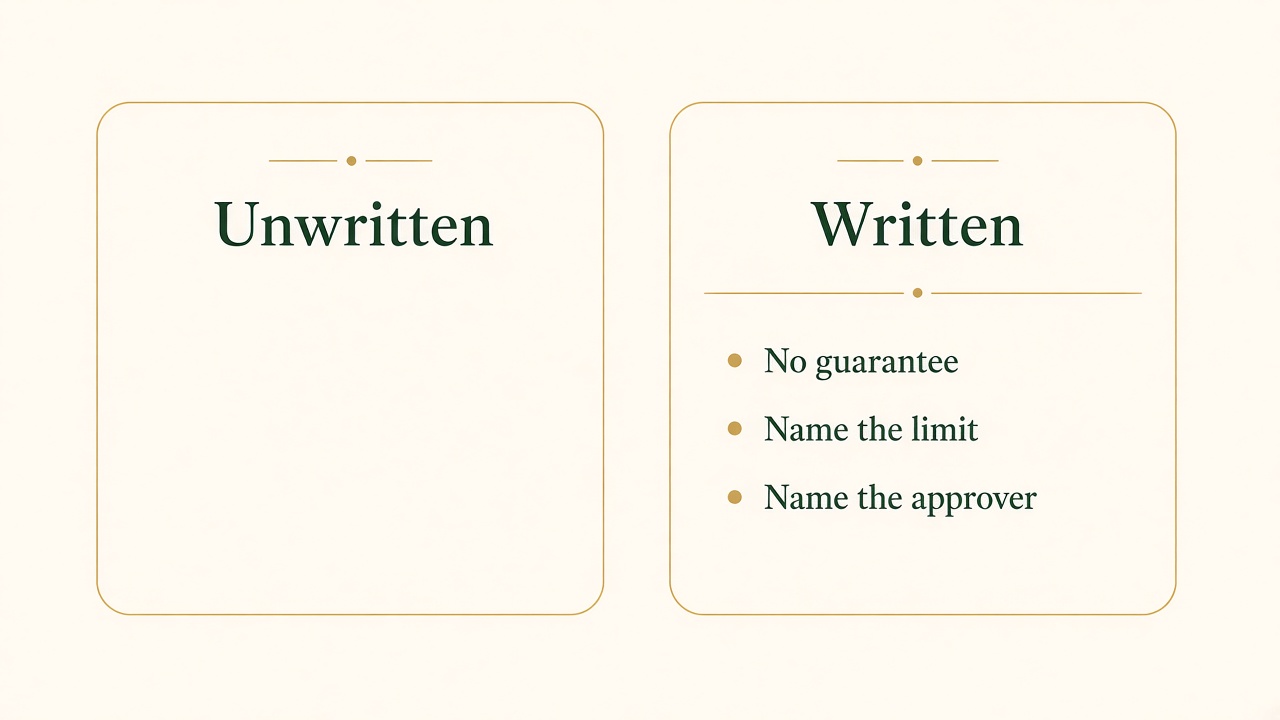
Unwritten rules do not reach the draft
A voice that stays in someone’s head is averaged away. The refusals, the limit, and the approver have to be written down.
Voice that lives only in a founder’s head does not survive a draft. The model was not in the room when you decided never to say “guarantee,” never to call yourself an agency, and never to describe a limit as a benefit. If those decisions are not written, the draft will average you with every similar company it has seen. The result can be grammatical, polite, and unrecognizable. Brand guidelines exist so a second person, or a tool, can apply the same refusals you would apply if you had typed the sentence.
The guidelines that work are short enough to check. They name the reader. They name the words you use for the product and the words you will not use. They list claims that are forbidden even if they would “sound stronger.” They say who may approve a page. They point at the source for a fact, such as the current product page, not “general knowledge.” A paragraph that says the brand is innovative, trusted, and customer-centric is not a guide. Every company can paste that paragraph. None of it tells a reviewer to delete a sentence.
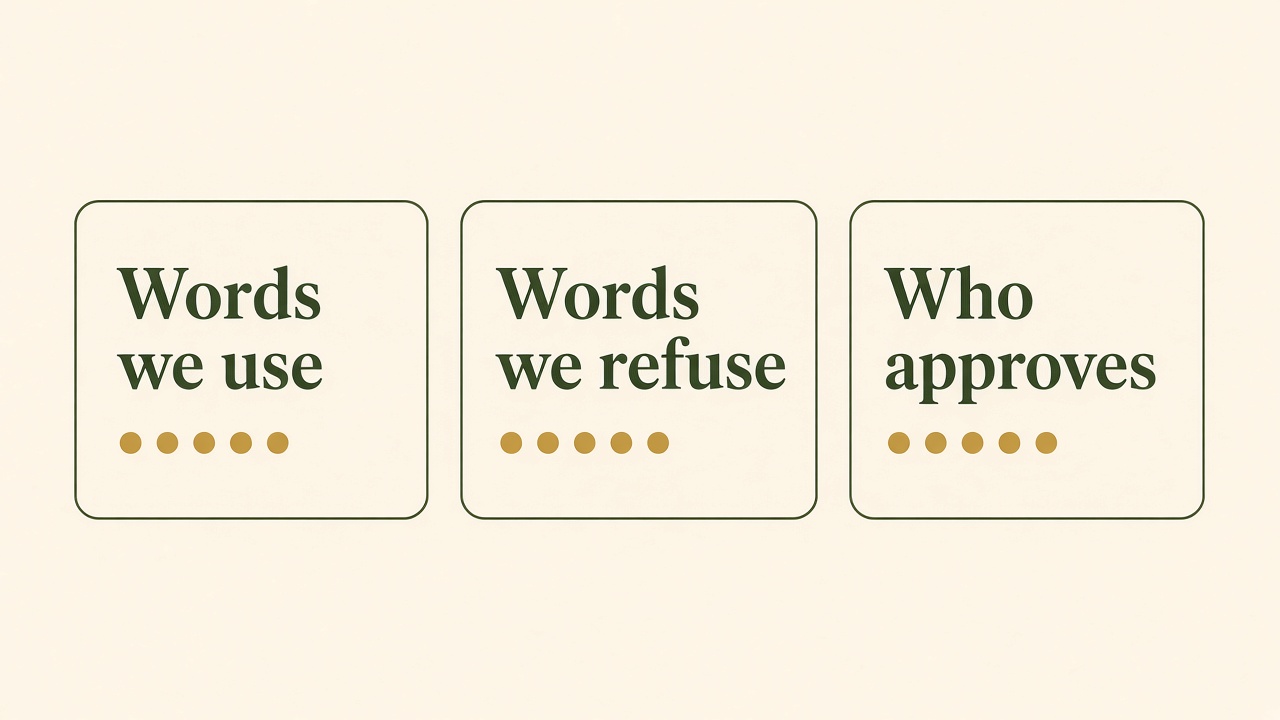
Use, refuse, and name the approver
A usable guide names the words you will say, the words you will not say, and the person who may approve the page.
On BloGoose, those notes are a set of brand files: eight editable context files for voice, style, keywords, SEO rules, and product information. They are useful because a person can change them, and a later draft can be built from the change. They are not useful because a file exists. If the product file still describes a feature you removed, every article that reads it will describe the feature you removed, in a consistent voice. Consistency with a stale file is a governed mistake. Updating the file is part of the brand, not a chore beside it.
Google’s people-first content guidance asks who created the page, whether it shows first-hand knowledge, and whether automation, including AI, is something a visitor would reasonably want explained. A brand guide belongs in that picture. The byline should be a person who can stand behind the page. The guide should say when you disclose that a tool drafted and a person corrected. Disclosure is not a substitute for the correction. A footer that says “AI-assisted” on a page full of invented proof is a labeled falsehood. I would rather the guide require the proof, and mention the tool only where a reader would ask how the page was made.
Governance starts here, before any legal specialty. AI brand governance, as I use the term, is three things you can point to: the written rules, the named person who checks a draft against them, and a record of what was approved. A score that says the draft matches a tone is not the third thing. A calendar full of scheduled posts is not the second thing. If you cannot say who read the page, you do not have governance. You have a stylesheet.
A style guide a drafting tool can actually follow
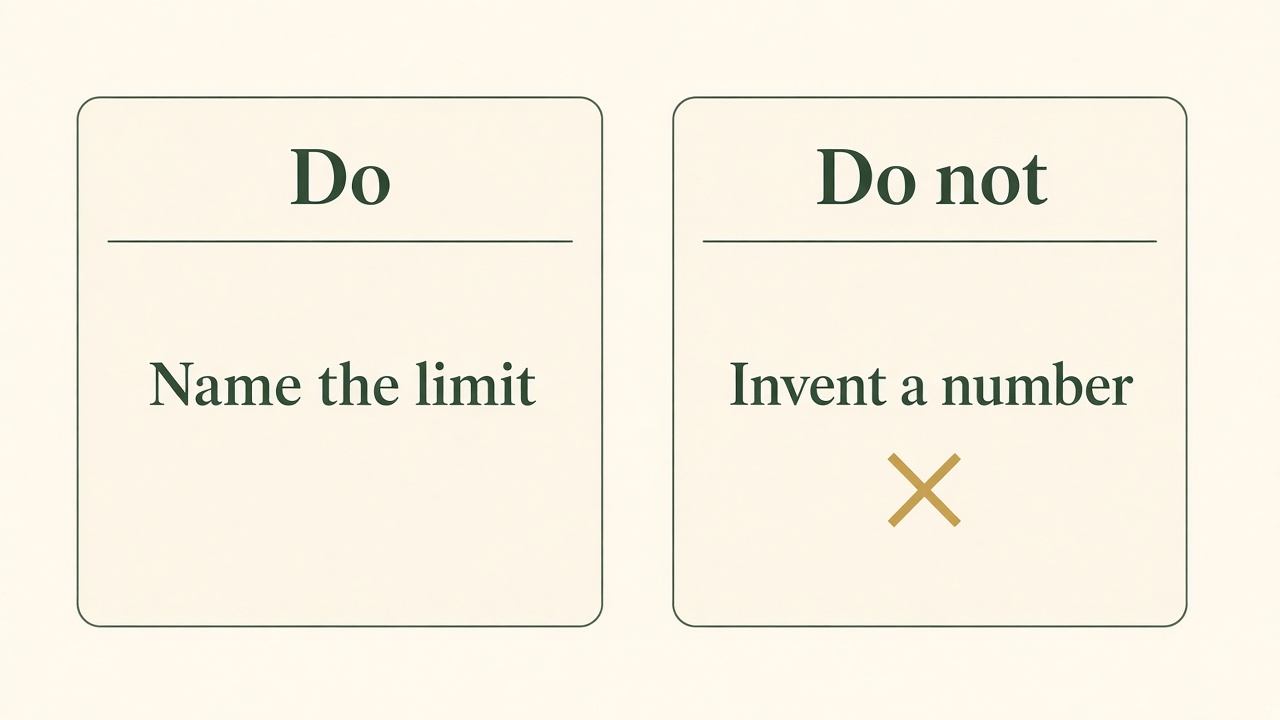
A line a reviewer can point at
Name the limit in the same sentence as the claim. Do not invent a number. “Be on-brand” is not a rule a draft can violate in an obvious way.
Do AI tools follow custom style guides? They follow what the product loads into the draft. A brand book on a shared drive does not govern a model that never sees it. A pasted paragraph of adjectives is seen and then ignored in favor of a more common sentence. The guide has to be in the place the tool reads, in lines a draft can violate in an obvious way. BloGoose’s context files are one such place, if you fill them with rules rather than mood. Another product may use a system prompt, a template, or nothing. Ask what the tool reads. If the answer is “the user types a prompt,” the style guide is the prompt, and it will be different every time unless you stop that.
Write the guide as do and do not, with examples taken from your own product. Do name the product the way the interface names it. Do put the limit in the same sentence as the claim. Do use the reader’s words for the job they are trying to finish. Do not promise a ranking, a citation, a cure, or a return. Do not invent a customer, a number, or a review. Do not describe a plan, a price, or a geography you do not sell. Do not borrow a paragraph from a competitor and ask the tool to “make it ours.” Those lines are checkable. “Be on-brand” is not.
Can AI write in your brand’s tone? It can echo examples. If you give it three pages you actually published, it can produce a fourth that shares the sentence length and the refusals, until it does not. Tone breaks in the sentence you would not say: a superlative, a fake urgency, a softened limit, a joke that punches at a customer. The guide should include two or three of those failures, marked as failures, so the reviewer has a pattern and not only a vibe. The tool may still produce them. The examples tell the human what to cut. They do not program the model into obedience.
Keywords belong in the guide as the names you are willing to be found for, not as a quota. If the true name of the feature is “context files,” the draft should say context files when that is the feature, and it should not rotate through synonyms to look broader. SEO rules in the same file should say what you already believe: one page per real question, no near-duplicate URLs, no claims you cannot source. A keyword file that contradicts the voice file will be averaged into mush. When the files disagree, stop generating and fix the files. A draft is the wrong place to negotiate the brand.
How to create the guidelines is a short project, not a workshop with no document at the end. One person who can refuse a sentence writes the rules. A second person, if you have one, tries to apply them to an old page and notes which rules they could not use. You delete the rules that cannot be applied. You add the refusal that the test missed. You store the result where the tool reads it and where the reviewer can open it without hunting. Then you generate one draft and compare. The guide is ready when a reviewer can mark a sentence wrong by pointing at a line, not by saying it feels off. It is not ready when it is long.
Regional language is part of the same sheet if you publish in more than one place. A word that is ordinary in one market can be a regulated claim in another. A price in one currency copied into a page for another country is a false offer. The guide should say which market a draft is for, and it should forbid the model from “adapting” a claim for a new country by rewriting the law. Adaptation of a joke is a voice task. Adaptation of a promise is a compliance task. Do not put both in one unchecked instruction.
The human check before anything is public
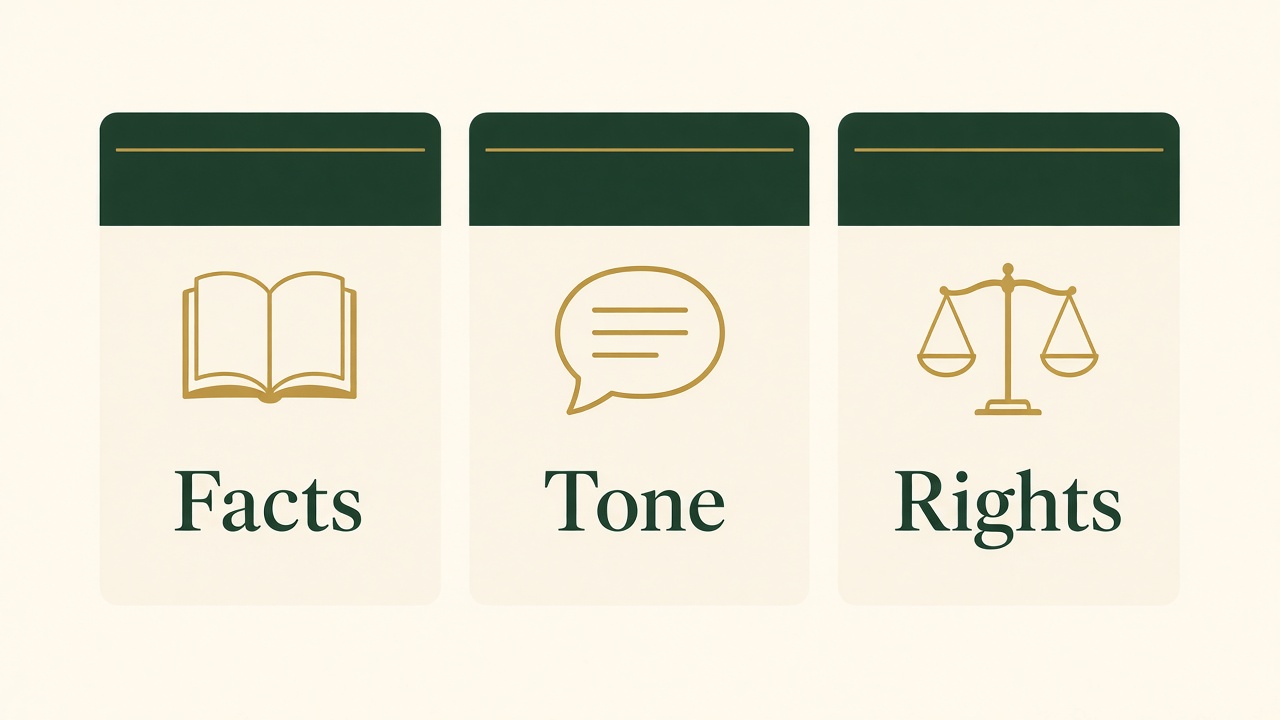
Facts, tone, and rights
A draft that can be published needs all three. Warmth does not clear a false number, and a matching vocabulary does not clear an image you do not have rights to.
Should you review every AI draft for compliance? Yes, if it can be published. The draft is not a private note once it has a URL, a caption, or a send button. The check is the one the site already asks for: facts, brand language, and media rights. On the homepage I say you own the facts, the tone, and the decision to publish. Those are not three optional passes for “important” posts. A tool does not know which post is important. You do, by reading it.
Facts are the sentences a customer or a regulator could test. Prices, ingredients, performance, “clinically,” “guaranteed,” “average return,” “FDA approved,” “no risk.” Google’s generative AI guidance says models predict words and can be wrong, and that you must review the output, including titles and image text, before publishing. A brand-voice pass that only listens for warmth will miss a false number said warmly. Read the draft with the source open. If there is no source, the sentence does not go out, however well it matches the guide.
Tone is the sentences a customer would recognize as yours, including the ones that refuse. A compliance check that only hunts for banned claims can still leave a page that sounds like a different company. Read it aloud. If you would not say it on a call, it is not your voice yet. If the guide forbids a word and the draft uses a synonym that means the same promise, treat the synonym as the forbidden word. Models are good at that swap. “Results may vary” under a headline that still promises the result is not a fix. Delete the headline.
Media rights are the pictures, video, music, and text you did not make. A draft that says “use a photo of a doctor” has not cleared the photo. A clip that uses a customer’s face has not cleared the face. A paragraph closely tracking someone else’s article is not “in your voice” because the adjectives changed. The U.S. Copyright Office’s explanation of fair use is the right caution here: fair use is a legal doctrine applied case by case, not a general permission to reuse what you found. I am not deciding fair use for your file. I am saying a model cannot decide it either. If you do not have a license, a release, or a reason you are willing to defend, do not publish the asset. The brand guide should say that in one line so the reviewer does not treat images as decoration.
Sensitive content needs a slower gate, not a cleverer prompt. Health details, financial specifics, and anything that identifies a private person should be in the guide as forbidden unless a named role has already approved that exact material. “Anonymize this case study” is how a draft keeps a detail that still identifies someone. If you cannot remove the detail, do not use the story. Regional rules differ, and I will not pretend one checklist covers every country you sell in. The human check includes asking whether this page is even allowed to make this kind of claim in the place it will be seen. If you do not know, you do not publish while you find out.
The check has a name on it. “The team reviewed it” is not a name. On a small company the name is often the founder, which is the oversight I can actually offer: I read what I publish. On your side, the name is whoever is allowed to bind the brand. A junior pass for spelling does not replace that person when the sentence is a claim. The subscription I sell does not include an editor, a lawyer, or a compliance officer. If you need those roles, they are yours. The draft can be ready for them. It cannot be them.
What brand files can and cannot govern
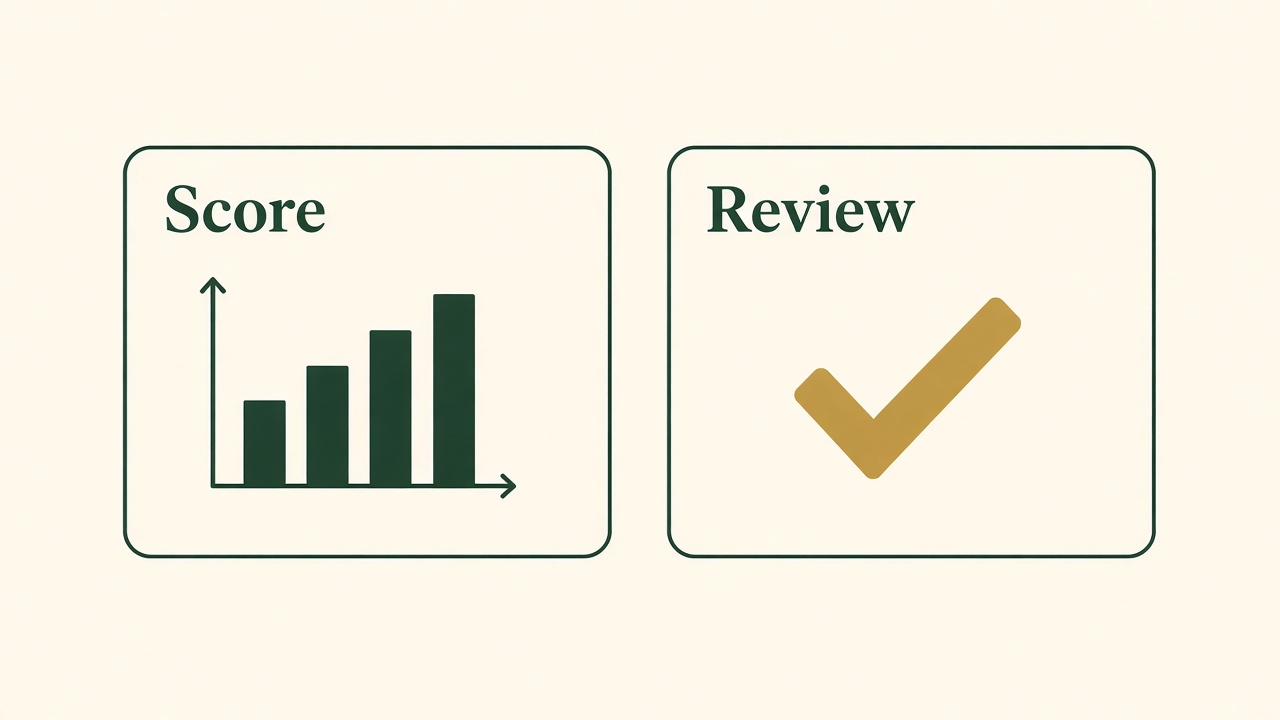
A score is not approval
A chart can point at something the tool knows how to count. The check mark belongs to the person who read the draft.
Tool features for governance are easy to over-read. A product can store your rules, apply them as context when it drafts, and show you a score for things it knows how to count, such as whether a heading is missing. That is useful. It is not a system of record for the law. BloGoose’s brand files guide voice, style, keywords, SEO rules, and product facts because you can edit them. They do not block a sentence that violates a statute. They do not log a legal approval. They do not know which image you have rights to. If a vendor describes files like these as compliance automation, read the actual behavior. Storage and drafting are not enforcement.
Use the files as the input the reviewer will also use. When you reject a draft, change the file if the rejection should apply next time. If you only fix the draft, the next draft will make the same mistake in a new paragraph. That is the governance loop that is actually available in the product: edit the rule, regenerate or rewrite, read again. A score can point at a thin section. It cannot tell you that “supports heart health” is a claim you are not allowed to make. Leave that judgment out of the score and in the review. What to read on the draft once the brand rules are open is the AI content quality guide.
Learn how BloGoose’s brand context keeps your messaging consistent if you want to see those files in the product. Consistency here means later drafts can see the same voice and the same product facts you typed. It does not mean the messaging is lawful, current, or approved. BloGoose brand context is the notes. You are the control. I would rather you open the files, find a stale line, and fix it, than trust a label that says the brand is locked.
Other tools in a stack should not each keep a private copy of the voice. A video caption written from a different note than the article will drift, even if both notes were true on the day they were copied. Point both at the same product facts. When the fact changes, change the source the tools read, then review the assets that already shipped. How to keep that article and that clip on one fact, with separate publish dates, is the cross-channel content workflow. Governance that only looks forward will leave last month’s caption stating the old claim. The file is not finished when the next draft is better. It is finished when the public pages match it.
Do not add a governance feature you do not have by describing the workflow as if the software signs the page. I will not. The honest product sentence is: the files steer the draft, the person checks facts, tone, and rights, and nothing publishes as a substitute for that check. If your settings allow a post to go out when generation finishes, turn that off for any page that can carry a claim. Automatic publishing is a choice. It is a poor choice for the sentences this page is about.
Health and financial claims
This is not a case study of a client. I do not have a hospital or an investment adviser whose drafts I am allowed to describe, and I would not invent one. It is the reason a brand file is not enough when the sentence can affect someone’s health or someone’s money. The voice can be perfect and the claim can still be unlawful. The reviewer in those fields is often not the marketing owner alone.
For health-related products, the FTC’s Health Products Compliance Guidance states two principles that survive any tone of voice. Advertising must be truthful and not misleading. Before you disseminate an ad, you must have adequate substantiation for the objective claims it conveys. For claims about the health benefits or safety of foods, supplements, drugs, and similar products, the guidance says that substantiation is competent and reliable scientific evidence, not a confident paragraph. The FTC does not pre-approve those health claims. A model that writes “supports immunity” because that phrase is common has not produced evidence. Your guide should forbid health-benefit sentences unless a qualified person has already attached the support and approved the exact wording. Generating the sentence first and “finding a study later” is the reverse of that order.
Prescription-drug advertising is a different regime from a supplement caption, and I am not going to blur them. The FDA’s overview of prescription drug promotion distinguishes the agencies: the FDA regulates advertising for prescription drugs, and the FTC regulates advertising for over-the-counter drug products. The FDA discussion of common problems includes overstating how well a drug works, minimizing risks, and leaving out the balance between benefit and risk. A brand voice that is warm does not satisfy fair balance. A short social cut that keeps the benefit and drops the risk is the failure mode, not a creative format. If you market a prescription product, this page is not your procedure. Your regulatory review is. A context file must not be where risk information goes to be shortened by a model.
Financial advertising has its own substantiation rule when you are an investment adviser speaking to clients. The SEC staff’s risk alert on the adviser marketing rule describes examinations that look for a reasonable basis to substantiate material statements of fact, for performance advertising that follows the rule, and for statements that are fair and balanced about risks and limits. An untrue material fact, or a benefit described without the material risk, is the kind of problem the alert lists. I am not applying that rule to your firm. I am saying a drafting tool does not have the reasonable basis. If the draft says a strategy “outperforms” or shows a return without the period, the fees, and the risk, the brand guide should have already banned the shape of that sentence. The compliance person bans it for a legal reason. The guide bans it so the model is not invited to write it.
The practical case, for either industry, is the same sequence. Decide whether this topic is allowed to be drafted by a general tool at all. Many claims should be written by the specialist and only then checked for plain language, not the other way around. If a draft is allowed, the guide lists the forbidden shapes: cures, guarantees, typical results, “FDA approved” when you mean something else, performance without the conditions. The specialist reviews the claims. Someone else may review the voice. Neither review is optional, and neither is the model. Publishing a health or money page because the tone score was high is the governance failure this section exists to name.
Personal data sits beside those claims. A healthcare story that includes a condition, a financial story that includes an account, or a prompt that pastes a customer’s email into a tool may be a privacy problem before it is a writing problem. Do not put identifiable records into a prompt to “make it sound like us.” The guide should say what must never be pasted. I am not citing a full privacy statute here, because which one applies depends on who you are and where the person is. The brand rule can still be absolute: no customer records in the draft. If the story cannot be told without them, it waits for counsel, not for a clearer prompt.
Audits, updates, and the rules you keep
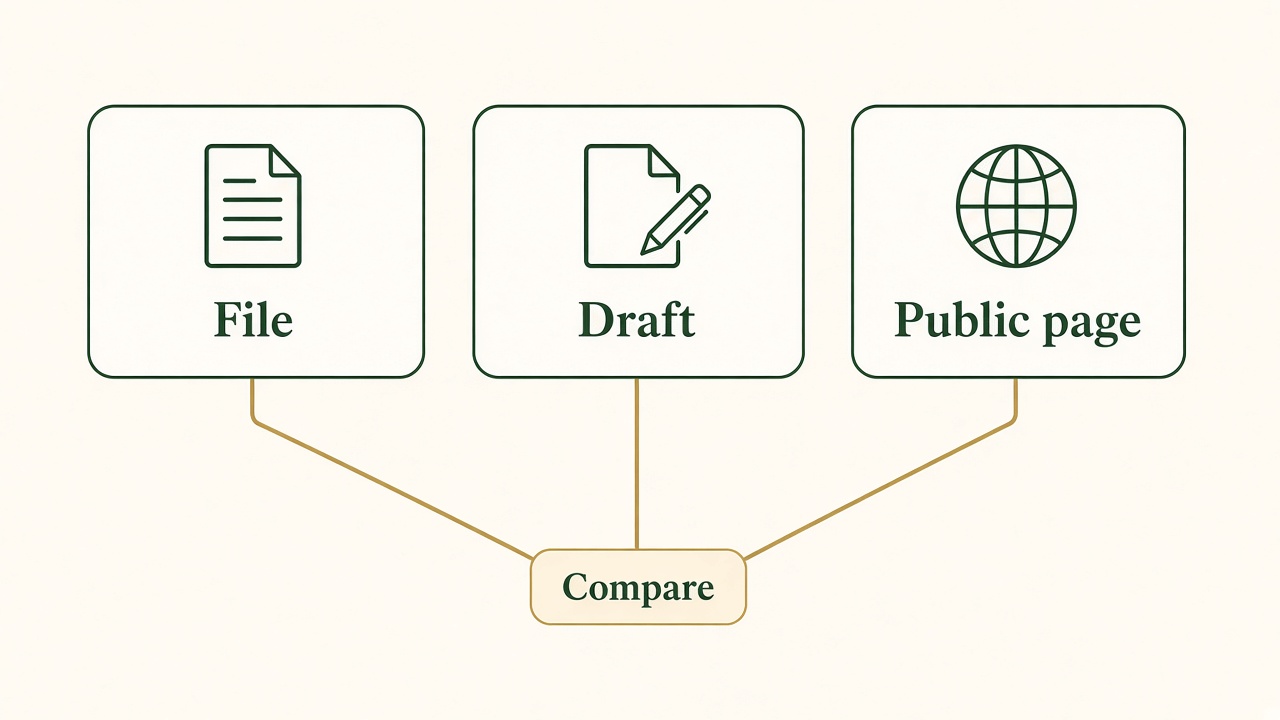
Compare the file, the draft, and the live page
Drift is a public page that still states the old limit, a file that states the new one, and a draft that mixes them.
A guide that was true at launch becomes a liability when the product, the price, or the claim you are willing to make has changed. Best practice is a scheduled reread, not a hope that someone will notice. Pick a cadence you will keep. For a small company that might be each time the product changes, plus a pass on a fixed day each month for the pages that mention numbers. The audit compares three things: the context files, a sample of what the tool drafted since the last change, and a sample of what is still public. You are looking for drift. The public page says the old limit. The file says the new limit. The draft mixes them. Fix the file first, then the public page, then the habit that let the mix ship.
Update the rules in the file, not in a chat beside it. If counsel tells you a phrase is no longer acceptable, that phrase goes into the do-not list the tool reads. If a campaign ends, the urgency lines come out. If a market is added, the guide gains a line about which claims travel and which do not. Leaving the update in an email means the next draft never sees it. Brand governance is boring on purpose. The record is the file and the name of the person who changed it, with the date. You do not need a new system to write “removed ‘clinically proven’ on this date, because we do not have that evidence.”
Sample more heavily where the harm is higher. A product blog about a feature can be sampled. A page that mentions health, money, safety, or other people’s creative work should be read in full every time it is generated, not every tenth time. “Should I review every draft?” is answered by the downside of the sentence, not by your confidence in the model. High confidence is how a false claim gets a consistent voice. Consistency is not a defense.
Keep the audit tied to publishing rights. Look at images and clips, not only verbs. A page can pass the word list and still use a photo you do not have rights to, a customer face you did not release, or music the tool attached. Media rights are part of the monthly pass because they are part of the publishing duty already stated on the site. If you cannot tell where an asset came from, treat it as not cleared.
Retire rules that you cannot enforce. A guide that says “always be empathetic” will not change a draft. A guide that says “do not tell the reader how they feel” will. During the audit, delete lines nobody can apply, and add the line that would have caught the worst sentence you published that month. The guide should get shorter and sharper. It should not become a manual nobody opens. The person who owns founder review on a small team is also the person who must be able to open the file in one step. If it takes a meeting to find the rules, the rules are not governing the next draft.
I will keep my own pages to that standard. The voice is mine. The facts are the ones I can point to. The tools can draft. They do not approve. Learn how BloGoose’s brand context keeps your messaging consistent if you want the files that hold voice and product facts for a draft. Bring the rules you are willing to enforce. The product will not invent your legal limits, and it will not notice when you have outgrown the ones you typed last year.
Questions about voice and governance
How do I keep my brand voice consistent with AI writing?
Write the voice as rules and examples a reviewer can apply, and put those rules where the draft is generated from. Include the words you refuse, not only the words you like. Then read the draft. A model can imitate a pattern from your notes and still produce a sentence you would not say. Consistency is the review catching that sentence, then the file being updated so the next draft is less likely to repeat it.
Do AI tools follow custom style guides?
They follow the text the product actually loads. A guide the tool cannot see does nothing. A guide it can see still does not bind it. BloGoose can use editable context files for voice, style, keywords, SEO rules, and product information, if you write rules rather than slogans. The draft can drift anyway. Treat the guide as an input and the human read as the control.
Can AI write in my brand’s tone?
It can resemble pages and examples you supply. Tone also includes the limit, the refusal, and the decision not to flatter the reader. Those are easier to miss because a warmer sentence often looks “more on brand” to a model. You decide whether the sentence is yours. If you would not say it, it is not your tone, even if it shares your vocabulary.
How do I create content guidelines for AI?
Write a short do and do-not list: the reader, the allowed facts, the forbidden claims, how names and proof are handled, and who approves. Test the list on an old page. Delete any rule you cannot apply. Store it where the tool reads it and where the reviewer can open it. Add a failure only after a real draft makes that failure. Do not start from “sound professional.”
What is AI brand governance?
It is the written rules, the named person who checks drafts against them, and a record of what was approved and when a rule changed. It includes facts, tone, and the right to use images and other media. It is not a tone score, and it is not a legal opinion. If a draft can publish with no name on the review, the governance is not in place.
Should I review every AI draft for compliance?
Yes, before it is public. At minimum, check facts, brand language, and media rights, which is the duty already stated for these tools. Health claims, financial claims, and anything that uses someone else’s personal information need a stricter review by someone responsible for that rule. A context file does not perform that review. Skipping “small” posts is how a small post carries a large claim.
The files hold the voice. You hold the approval. Learn how BloGoose’s brand context keeps your messaging consistent if you want those notes in the draft. The founder review on the homepage is the part the software does not do.
Learn how BloGoose’s brand context keeps your messaging consistentYou still check facts, tone, and media rights before publishing. The file is not the check.