
A practical guide
Founder-Led Software: The Verthilix Difference
Founder-led, on this site, is not a style of leadership essay. It is a name. I am Roktim Saha. I build Verthilix. If you write about a bug in the software I sell, the reply comes from me. The homepage says the work is founder-led, built in India, and not an agency. The line under that is the one I want this page to keep: useful software, with a person behind it.
A large software company can be the right vendor. It can staff a queue, survive a holiday, and put a hundred people on a product. I am not that company. I am one developer who has spent 12+ years in the field, who still writes the products, and who has published the price, the limits, and the support window where you can read them without a call. The difference is that narrow. It is an advantage only if you want the person who made the tool to be the person who answers. If you want a department, this is the wrong fit, and I would rather say so here than after you have paid.
Nothing in the studies I link below is a result for Verthilix. They describe other founder-led firms. I use them so the word has a public meaning, and then I come back to the sentences on my own site. Those sentences are the ones you can hold me to.
What “founder-led” means here
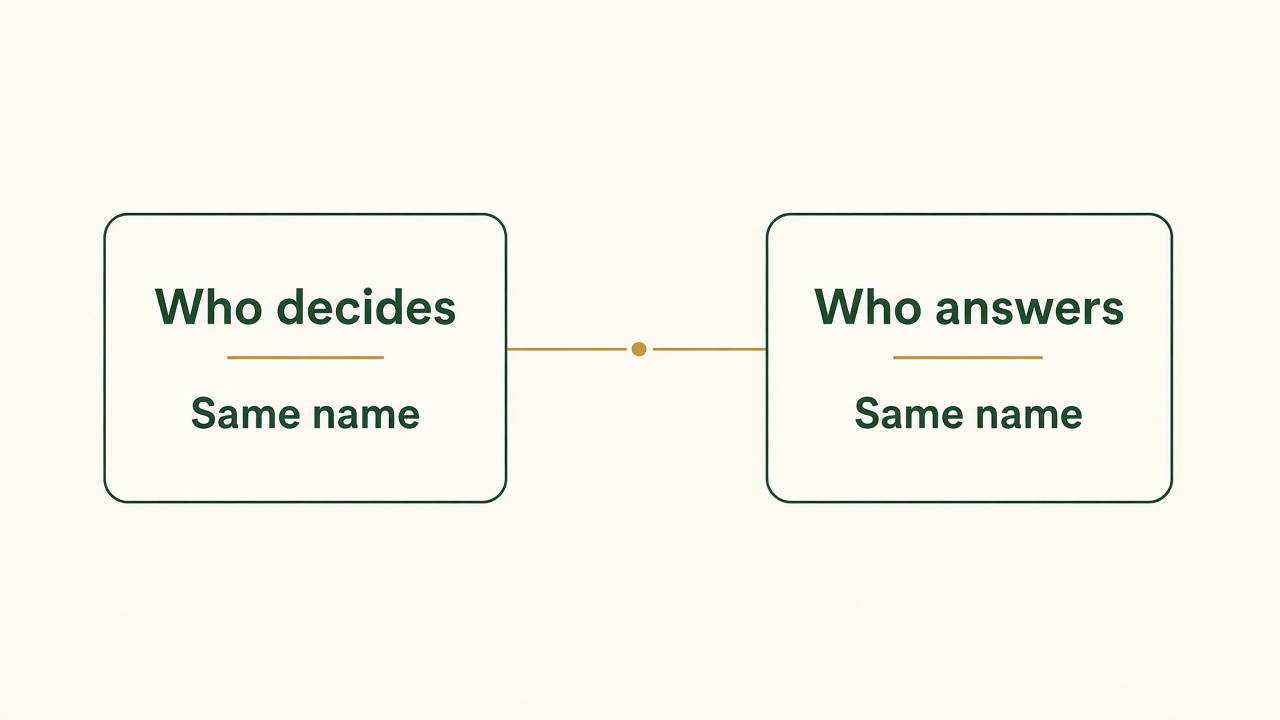
Who decides and who answers
At Verthilix those are the same name. There is no second executive and no separate support department.
A company is founder-led when the founder is still responsible for the product, not when the about page mentions a founder who left the building. At Verthilix the about section is in the first person. I am a software developer based in India. I build digital products that help individuals, teams, and businesses communicate, create, and make everyday work easier. Verthilix is the home for that work: useful software, with a person responsible for improving it. The person is not a team I have not named.
That is also why the site says it is not an agency. An agency sells hours and a roster. I sell software access and, for Vlozy and BloGoose, direct product support from the person who builds them. You still review what you publish. I do not become your writer, your editor, or your account manager by sending an invoice. The homepage FAQ is explicit that the offer does not include those roles, and that it does not promise rankings, AI citations, leads, or sales. Founder-led is not a softer way to make those promises. It is a harder way to avoid them, because my name is on the page.
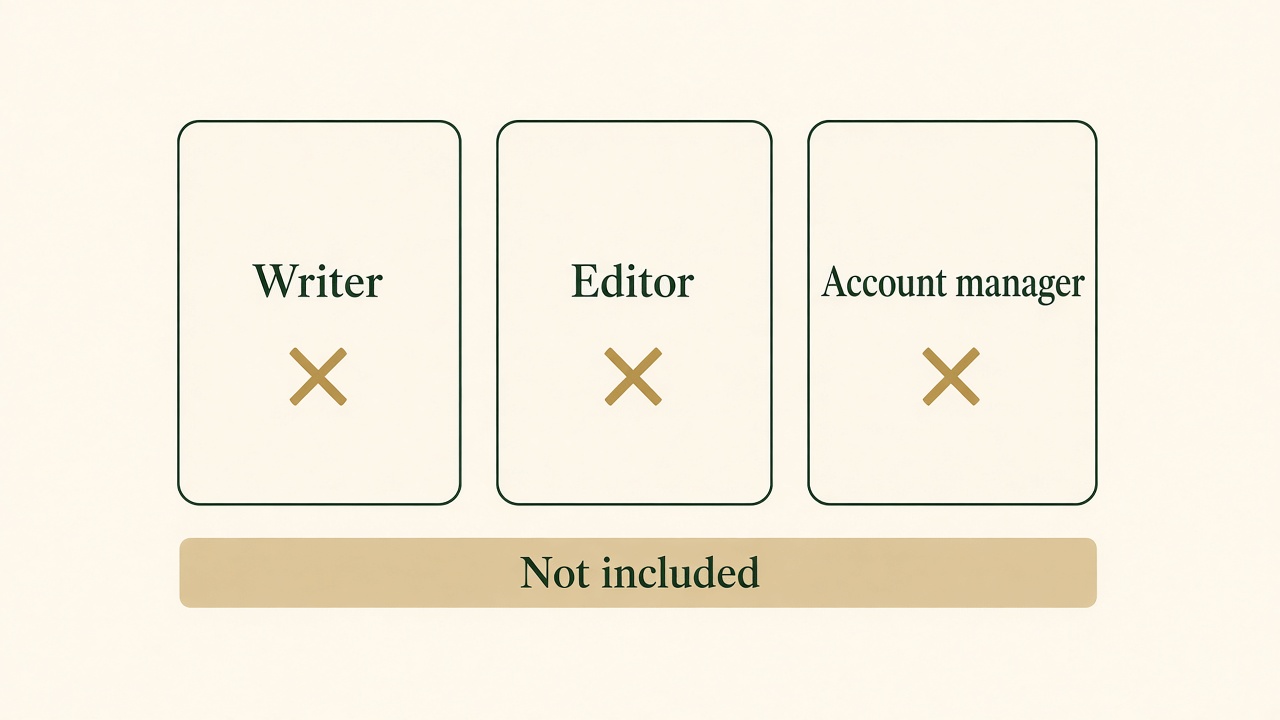
Not a writer, an editor, or an account manager
The offer is software and direct product support. It does not include those roles, and it does not promise rankings, citations, leads, or sales.
People use “founder-led” for very large companies as well. Harvard Business Review’s essay on the strengths and weaknesses that set founders apart describes a public argument, sparked in part by Paul Graham’s “Founder Mode” essay, about how a company still run by its founder differs from one run by professional managers. Graham’s essay is about founders who already have managers. I am not in that argument as a case. Verthilix is not a firm choosing between a founder and a hired chief executive. There is no second executive. The useful part of the public discussion, for a buyer, is the question it forces: who actually decides, and who actually answers? Here, both answers are the same name.
MIT Sloan Management Review’s article on founder-led companies names advantages that show up in that literature: deep domain familiarity that is hard to hand to a new manager, and a legitimacy that comes from having built the thing rather than inherited it. I recognize the shape. I have spent the years on web development, PHP and MySQL, automation, and content systems, and I still use that work in the products. I do not treat an essay about other companies as evidence that my decisions will be better than a larger vendor’s. Familiarity cuts both ways. I can change a product quickly because I do not have a committee. I can also be wrong quickly, for the same reason. The correction is public when I change the page, not buried in a brand campaign.
Google’s guidance on people-first content asks who created a page and whether it shows first-hand knowledge. I hold this site to that question. The guides name me. The product pages name what the software does and what it refuses. If a sentence on Verthilix could have been written by a committee that had never opened the product, it does not belong. Founder-led, as a content practice, is that test. As a company practice, it is the support address and the terms, which are the next section.
What changes when one person builds it
A solo developer is not automatically faster, kinder, or cheaper. The specific change is the path of a decision. If a screen is confusing, I can see it, because I also use the product and I read the messages. If a limit is easy to misunderstand, I can rewrite the sentence on the offer page without waiting for a marketing calendar. The homepage describes the approach in plain steps: start with the task a person is trying to complete, work toward a useful first version, explain what it does, and improve it from real use. That is the agility I will claim. It is not a methodology badge. It is a short loop because there is no one else to hand the loop to.
Direct communication is the same loop. You do not need an account manager to introduce you to the builder. The contact on the site is mine. Email [email protected], or use the form, and say which product you mean. For an account you already have, use the support details on that product or on the billing page. I would rather a short email with the bug than a polished brief that never reaches the person who can reproduce it. Personal support helps when the person who receives the report can change the software or can tell you, in the same thread, that the behavior is the limit and not a bug. A large firm’s support can be excellent and still be unable to change the product during your conversation. Mine can change it, and it can also be unavailable when I am the only one in the thread. Both are the deal.
Harvard Business School’s Working Knowledge note on hands-on founders reports a study of founders of Indian software companies. The researchers describe a hands-on style as keeping close track of the work: expectations, milestones, and whether the work is moving. In that study, founders who took that style more seriously saw fewer people leave and firms that were less likely to have closed when the researchers looked again. I cite it as research about other Indian software founders, not as a result I measured at Verthilix. I do not have employees whose retention I can report. The part I take seriously is the habit: the work has an owner, a next step, and a check. On a one-person product, that owner is me, and the check is whether the software does what the page says.
There is a weakness in the same arrangement, and the HBR conversation about founders is partly about weakness. A founder can stay too close to an old decision. A founder can explain the product in the way it was built rather than the way a buyer meets it. I try to correct that by writing the refusal on the page: what is not included, what is not promised, what you still have to review. If the explanation only makes sense to me, it is not finished. Direct communication includes being told the sentence is unclear. I would rather hear that than defend a paragraph.
Choosing a small firm over a large one is a trade, not a moral win. Choose the small one when the product is specific, the limits are acceptable, and you want the builder on the email. Choose the large one when you need a team on your clock, a contract your lawyers already know, or a product that must not depend on one person’s week. I will not argue you out of the second choice. Verthilix is the first choice, stated without the costume of a bigger company.
Hands-on support, with a clock
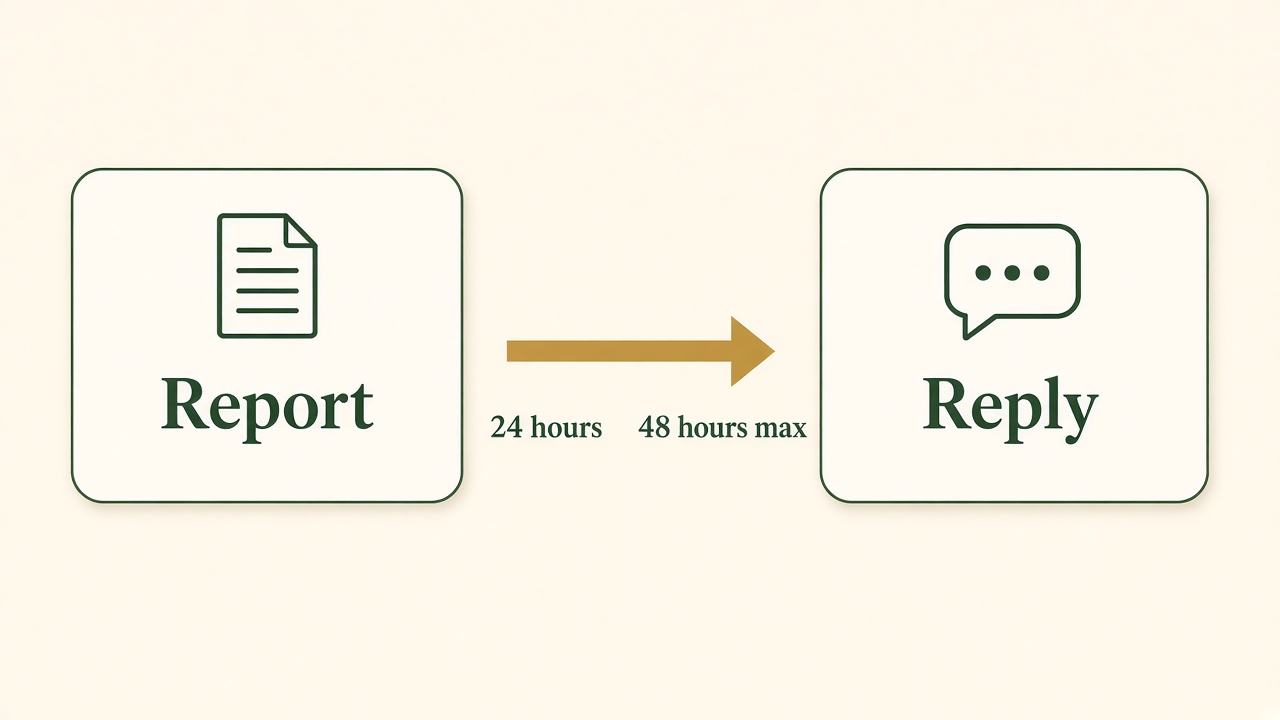
Toward a resolution, not a finished draft
For a bug in Vlozy or BloGoose, I work toward a resolution within 24 hours. Forty-eight hours is the maximum from when I receive the report. That is not a promise for how fast a draft or a video is made.
The support promise is written down, and it is narrower than “I am always here.” The terms call it Roktim’s Direct Support Guarantee. If an issue or a bug comes up in Vlozy or BloGoose, you email me at [email protected] from the address on the account. I commit to working with you toward a resolution within 24 hours, with 48 hours as the guaranteed maximum from the time I receive the report. The homepage FAQ says the same thing and adds the boundary that matters: that is support time, not a promise for how fast a draft is made. A model can be slow. A third-party network can be down. The clock is about the bug you reported to me, not about a video appearing on a schedule you hoped for.
The direct founder support line on the Growth Duo page is this guarantee, not a concierge. The offer also says you review what goes live. I can help when the product misbehaves. I do not take the review off your desk. If the draft is factually wrong because the page it read is wrong, the fix may be your source, not a bug. If the button fails, that is the report I want, from the registered address, so I know which account I am looking at. Writing from a different address slows the same clock, because I have to find you before I can find the fault.
Quality, in this setup, is the product matching the page after that report, not a separate quality department. Software may produce errors. The terms say so. Integrations depend on other companies and on whether an account is eligible for a given network. I may maintain, update, or restrict a feature for security, technical reasons, or abuse prevention. Those sentences are part of the support story. A founder who promises a spotless tool is selling a different product. I promise a response window and a person who can change the code. I do not promise that the first reply is the final fix. “Toward a resolution” is the wording in the terms. I am keeping it.
Personal support helps most when the problem is specific. “It does not work” is harder to resolve in 24 hours than “this account, this post, this error, this time.” The window is mine to keep once the report is clear enough to act on. If I need a step from you, the clock is not a reason for either of us to guess. Send the step. I would rather use the 48 hours on the real fault than on a polite exchange that never reaches it.
This is also why the support address is public. You should not have to earn a conversation with the person who sold you the software. Contact Roktim directly to discuss your needs before you buy, too, if you are unsure the product fits. Tell me the task. I will tell you if it is the wrong tool. That conversation is not a custom-software engagement unless we write one. The default offer is the software on the page, with the support window in the terms, not a blank check for new features.
A price you can read, and a person you can email
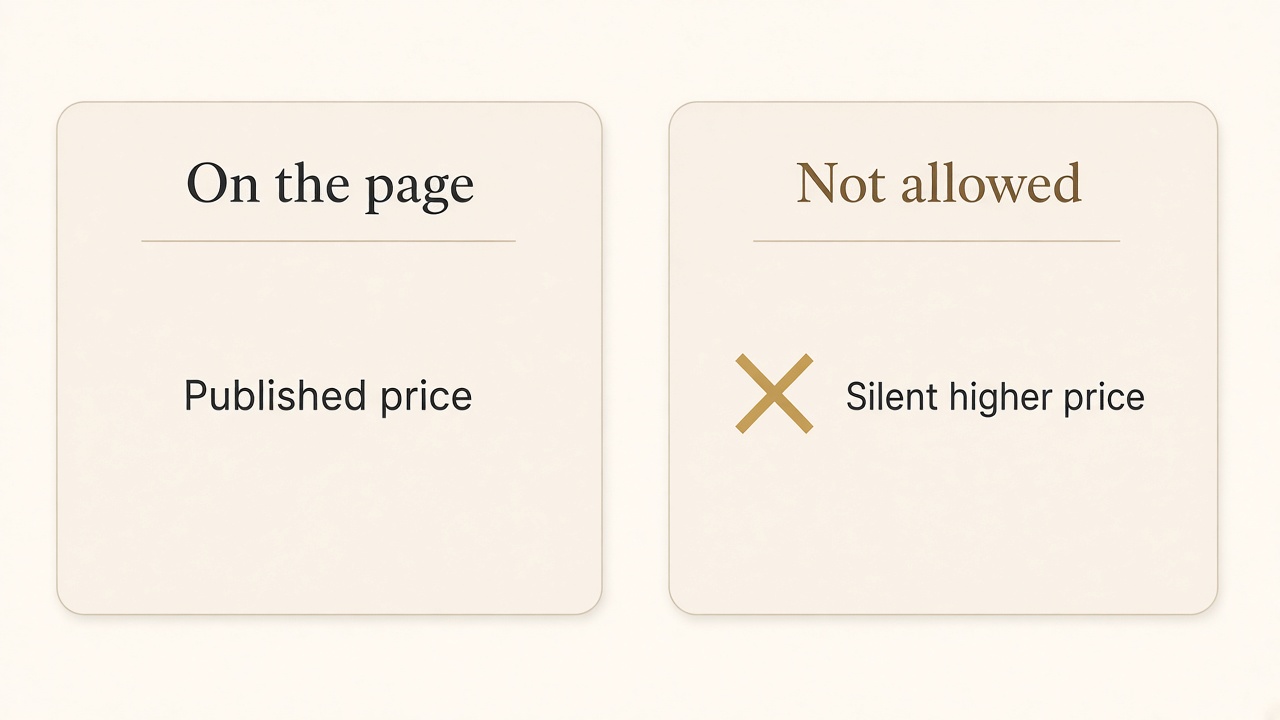
Read the number on the page
A materially different recurring charge has to be disclosed before it applies. A higher charge is not authorized by a silent edit.
Small vendors are not automatically more honest. They are easier to check when the price, the limits, and the refund rule are on a URL. The Growth Duo is $2,999 USD per month for Vlozy and BloGoose together. One subscription. Two separate logins. The offer page states the publishing limit on Vlozy, the article allowance and the single seat on BloGoose, and what is not included. The terms repeat the price as the total for both products. I am not going to restate every allowance in this essay and risk a second, drifting copy. The offer page and the terms are the record. If this page and those pages ever disagree, those pages win, and this page should be corrected.
How pricing differs from a large vendor, here, is that there is not a second price hiding behind a sales qualification. The terms say a materially different price or a different recurring charge has to be disclosed before it applies, and that I do not authorize a higher charge through a silent edit of the website. That is the transparency I mean. It is not a claim that the number is low, or that it will suit a one-person shop with occasional posts. The homepage already says to compare the individual tools if you only need occasional content, and to read the price before you treat the bundle as the default. A small vendor can still be the wrong price. The advantage is that you can see the number before the call, and the call does not invent a new one.
The refund rule is part of the same transparency, and it is strict. Successful payments are non-refundable. The first month is compulsory. You can cancel, including before the month ends, and access is removed when cancellation is confirmed. There is no pro-rata credit for unused time. The refund policy is the page to read before you pay. I will not soften it on a founder-led essay. Personal support does not include a quiet exception to a published refund rule. Mandatory rights that the law does not let me waive are the exception the terms already name. Anything else is a change to the policy, dated on the policy, not a favor in an email.
You can contact the founder without a gate. That is the “talk to the person in charge” part of a small company, and on this site the person in charge is the founder, not a separate chief executive I have not appointed. The contact form and [email protected] are the door. For a bug, use the address on the account so the support window applies cleanly. For a question about whether to buy, say what you are trying to publish and which product you think you need. I will answer as the person who has to live with the answer.
Trust is also the list of things the software will not do. Google’s guidance on generative AI content tells site owners to fact-check generated text before publishing, because a model predicts words and can be wrong. I build tools that draft. You still check facts before a page goes live, and you still own the tone and the decision to publish. How to write that check down, including the words you refuse, is the brand voice guide. A founder-led shop that hid behind “the AI said it” would be worse than a large vendor with an editor, not better. The person behind the software is the reason the review stays with a human, not the reason you may skip it.
What people have said, and what I will not add
The homepage has a section of notes from people I have worked with. I am not going to rewrite them into product reviews. They are short, and they are about dealing with me. In their words: “Awesome to deal with. Offered great advice and made the process very easy.” “Very easy to work with.” “Great job! Highly recommended! Fantastic help through the process post sale.” “Great transaction and a great man to do the deal with.” There are also two video messages and a voice note, left as they were sent. You can read and play them on the homepage. I do not add names here that the notes do not print as captions in the article text, and I do not turn a comment about a transaction into a claim that the Growth Duo produced a business result.
Personal care, if I am going to use the phrase, is that record plus the support window, not a community I have not built. There is no member forum I am describing on this page. There is no public vote on the roadmap. What there is, is a way to reach me, and a habit of changing the product from real use. The about section says I start with the task, ship a useful first version, and improve it when real use shows what is confusing. The terms say I may update or restrict a feature. A flexible roadmap, in those words, is not a promise to build the feature you sketched in an email. It is a statement that the software is not frozen, and that the person who can change it is the person who reads the mail. If a change would alter the price or the billing, the terms already require disclosure before it applies. A feature change is not a silent new charge.
I will not collect those notes into a score. Four kind sentences are not a rating, and they are not a reason to expect the same sentence from the next person. They are evidence that some people found the work direct. The evidence you should use before you pay is still the product page, the limit, the price, and the terms. A founder who leads with testimonials and buries the refund rule is using the personal tone as cover. The refund rule is above, on purpose.
How a one-person software business holds together
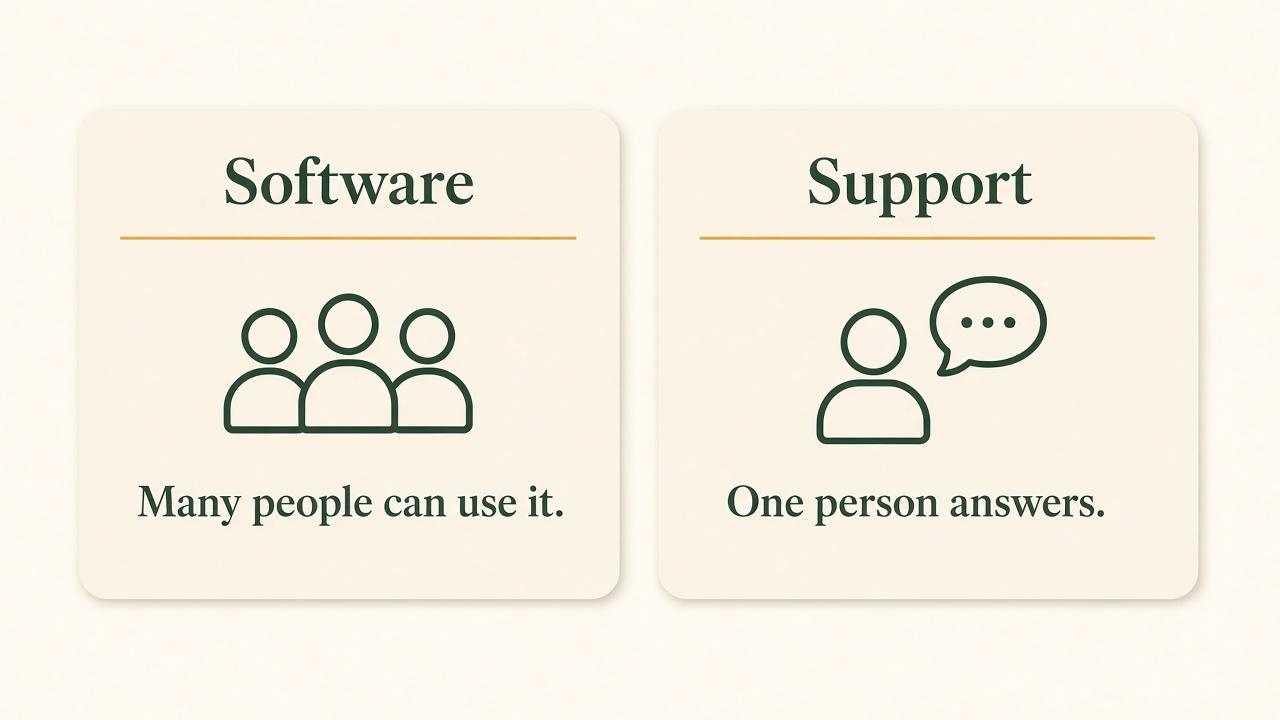
The software can travel. The inbox cannot
A page can be used by people I will never meet. The 24-hour and 48-hour support window is still one person.
Can a solo developer’s company scale? The software can. A page can be used by people I will never meet. A publishing limit can be large. The attention cannot scale the same way, and I am not going to pretend it does. Vlozy on the offer has a stated cap on successfully published posts and does not cap generation in the way the offer describes. BloGoose on the offer includes one seat. Those numbers are how the product scales inside a plan, not how I become a larger firm. If the support email is still mine, the 24-hour and 48-hour window is the constraint that keeps the promise true. Past that constraint, the honest move is a slower reply I have not promised, or a product change, not a fictional team.
I manage growth by keeping the catalog legible. Some products are separate from the bundle. VClar and SnapsJo are separate. Piveth was built here and now has a new owner. A future package is listed when it is ready to buy, not while it is an idea. That is how a founder-led list stays smaller than a corporate portfolio slide. Each product should be understandable without me in the room, and the ones I still support should have a page that says so. If I cannot explain a tool in a few accurate sentences, it is not ready to sit next to the others.
The operating habit is the one in the about section. Start with the task. Ship a first version a person can use. Explain it. Change it when use shows a confusion or a fault. Do not open a second front that breaks the support window. Hands-on, in the HBS sense of watching the work, means I notice when the queue of bugs and the queue of new ideas are the same hour. The bugs win, because the terms gave them a clock. New ideas wait. That is not a lack of ambition. It is how the guarantee stays a guarantee.
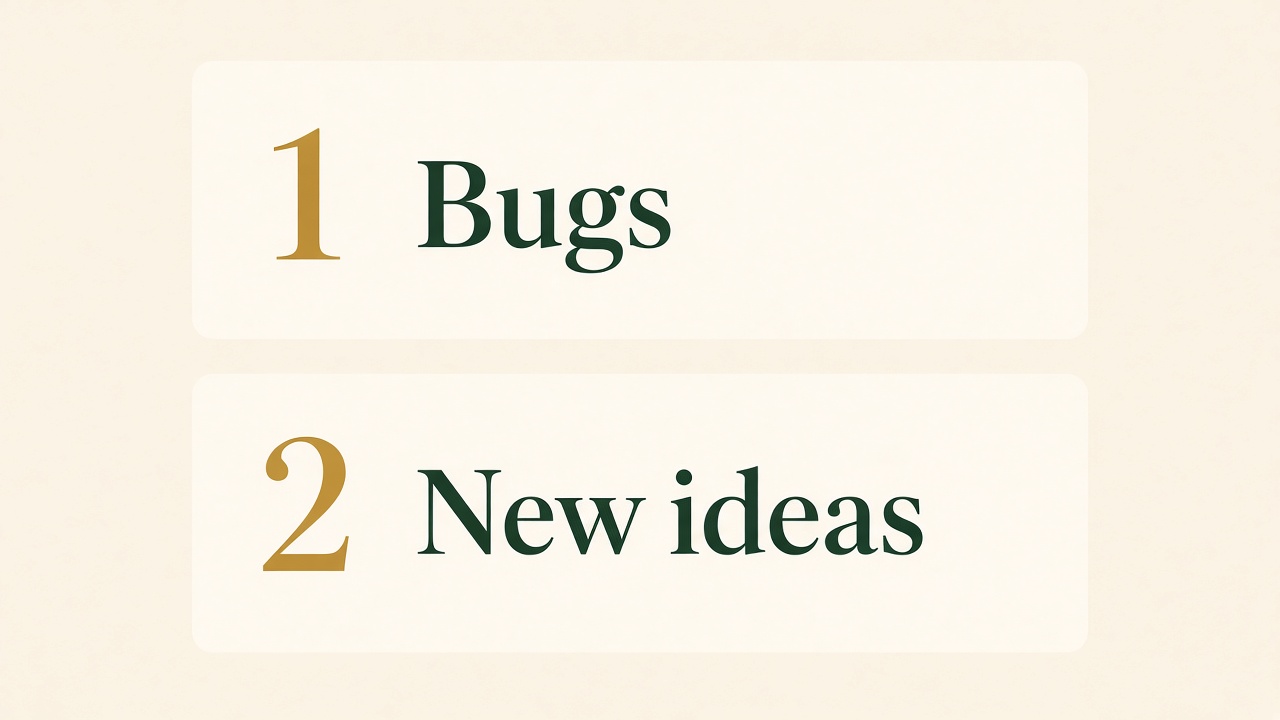
Bugs first, then new ideas
When both queues are the same hour, the report with a clock in the terms comes first. A new idea waits.
Balancing scale also means not borrowing the voice of a bigger company in the meantime. I will not say “we” for a department that is me. I will not say a success team will own your account. I will not say the roadmap is jointly owned by a community. You get the software, the published limits, and me on the problems the terms cover. If that is enough, the next step is the product page or the offer. If you need to talk first, contact Roktim directly to discuss your needs. Bring the task. I will tell you whether the tool I have is the one that does it.
The person responsible for improving the software is still the person who has to read this page and keep it true. That is the founder-led difference I am willing to print. Not a study. Not a slogan about small being beautiful. A name, a price, a clock, and a refusal to promise what the software does not do.
Questions about a founder-led software business
What are the advantages of a founder-led company?
The advantage you can check here is a named person. I build the product, the price and the limits are public, and a bug report in Vlozy or BloGoose comes to me inside the window in the terms. Writing about other founder-led firms describes expertise and hands-on management. I do not treat that writing as a performance claim for Verthilix. The advantage disappears if you needed a team, a negotiable price, or a promise of rankings.
Why choose a small software firm over a big corporation?
Choose the small firm when you want the builder on the email and you accept that there is one builder. A large company can offer coverage I do not offer. Verthilix is not an agency and not a support department. Read the product, the limit, and the refund rule. If those fit the task, the size is a match. If you need the department, choose the department.
How does personal customer support help?
It helps when the person who answers can also change the product or can tell you the behavior is the documented limit. For Vlozy and BloGoose, email [email protected] from the account address. I work toward a resolution within 24 hours, and 48 hours is the maximum from when I receive the report. That clock is not a production-time promise for a draft or a video, and it is not a promise of sales.
Can a solo developer company scale?
The software can serve people I do not meet. The support commitment cannot be copied onto a staff I do not have. The offer states a publishing limit and, for BloGoose, one seat. I keep the list of products small enough to explain, and I let the bug clock outrank a new idea. That is the scale I will run. It is not a plan to become a large corporation under the same promise.
What does “founder-led” mean in software?
It means the founder is still responsible for the product and the support, in public, under their own name. Here that is Roktim Saha, a software developer in India. The homepage calls the result useful software, with a person behind it, and a person responsible for improving it. It does not mean a founder appears in the marketing while someone else owns the inbox.
How is pricing different for small vendors?
This price is the one on the offer: $2,999 USD per month for both products, two logins, limits and exclusions written down. The terms say a materially different recurring charge has to be disclosed before it applies, and that a higher charge is not slipped in by a silent edit. Successful payments are non-refundable, and the first month is compulsory. Small does not mean a private discount. It means you can read the number first.
If you want to know whether the tool fits the task, contact Roktim directly to discuss your needs. The offer, including direct founder support, is the page that states the price. This essay does not change it.
Contact Roktim directly to discuss your needsEmail [email protected] if you prefer. For a bug on an existing account, use the address on that account.