
You ship one new feature on Tuesday. By Friday it needs a short clip and a search article, and the two quietly describe slightly different products.
That gap is normal. Separate drafts, separate tools, and late edits pull each format its own way. Keeping a consistent message across video and blog means both pieces tell one story, even though one is a quick clip and the other is a full article.
This guide gives you that one story across video and search in five steps: write a message sheet, source claims from your own site, split claims by format, match the voice, and check both pieces side by side. The drift usually starts before anyone writes a word.
Verthilix founder Roktim Saha says, "I watch where people struggle." This is a common sticking point for founders who turn website content into short videos and articles.
To keep the same message across short videos and blog articles, write one message sheet first and pull every claim from your own website. Give the video one claim and the article all of them. Match the voice, not the wording, and run a side-by-side claim check before publishing either piece.
What does a consistent message across video and blog mean?
A consistent message across video and blog is the same feature, the same claims, and the same voice in both formats, delivered at different depths. The clip states the core point, and the article expands on it without contradicting it.
Think of it like a map at two zoom levels. The city view and the street view show the same roads. One just shows more detail.
Message consistency is different from posting consistency. Many popular YouTube videos, including Jade Beason's, treat "consistent" as posting cadence, meaning how often you publish. Cadence matters for an audience, but it says nothing about whether your clip and article agree. Message consistency asks a narrower question: does every piece about one feature make the same promise, cite the same facts, and sound like the same company? You can post daily and still drift. You can also post rarely and stay perfectly aligned.
Messages usually drift for four reasons:
- Tool sprawl: the script and the article come from separate apps that never share notes.
- Different writers: two people interpret the same feature in two ways.
- Claims added during editing: a late "faster" or "easier" appears with no proof behind it.
- Voice shifts: the script sounds casual while the article sounds formal.
The fix starts with a source of truth, which is your own website pages: the place where your product is already explained and kept current.
Before you start, gather three things: your current site pages, one feature in scope, and one named reviewer. I build tools around this exact workflow, each picked for a specific job.
How to keep one message across video and blog in 4 steps
Write one message sheet, pull every claim from your own site, give the video one claim and the article all of them, then match the voice. Before you begin, have your live site pages open, one feature chosen, and your reviewer named.
Step 1: Write one message sheet before either format
Write the message sheet first, because this is where drift begins. A message sheet is a single page that fixes the feature, promise, claims, proof, voice, and call to action before any script or article exists. Set aside about 20 minutes.
| Field | What to write |
|---|---|
| Feature | The one feature in scope |
| One-line promise | What it does for the reader, in one sentence |
| Claims (max 3) | Specific, checkable statements |
| Proof page per claim | The site URL that backs each claim |
| Voice words (5) | How the piece should sound |
| Banned words | Words you never use |
| CTA | The single next step for the reader |
To stop a video and an article from contradicting each other, fill in a message sheet before drafting either one. List the feature, a one-line promise, no more than three claims, and the website page that proves each claim. Add five voice words, a short banned-word list, and one call to action. Both the script writer and the article writer work only from this sheet. You should finish with one page that your reviewer approves before production starts.
Step 2: Pull every claim from your own website
Source every claim from your live site pages, never from memory. For example, BloGoose reads your site before drafting, and then you review the facts against the proof pages on your sheet. This takes about 10 minutes. Success looks like this: every claim has a working URL beside it. For a full walkthrough, see how to reuse your website copy for both formats.
Step 3: Give the video one claim and the article all of them
Consistency doesn't mean identical copy. A clip can't carry every claim, so it shouldn't try to. Vlozy shows one feature per clip, which means the video carries one claim while the article covers all three.
Pro tip: Write the clip's single claim first, then make it the article's first H2. Readers who watch and then search will land on the same point.
When the same product knowledge feeds both formats, alignment is built in. The Growth Duo pairs short videos and researched articles in one subscription.
Step 4: Match the voice, not the wording
Keep the tone identical and let the sentences differ. Check both drafts against your voice words and banned words, which takes about 5 minutes.
| Voice words | Banned words |
|---|---|
| Plain | Revolutionary |
| Practical | Seamless |
| Direct | Game-changing |
| Specific | Effortless |
| Helpful | Best-in-class |
With both drafts written, the last job is proving they agree.
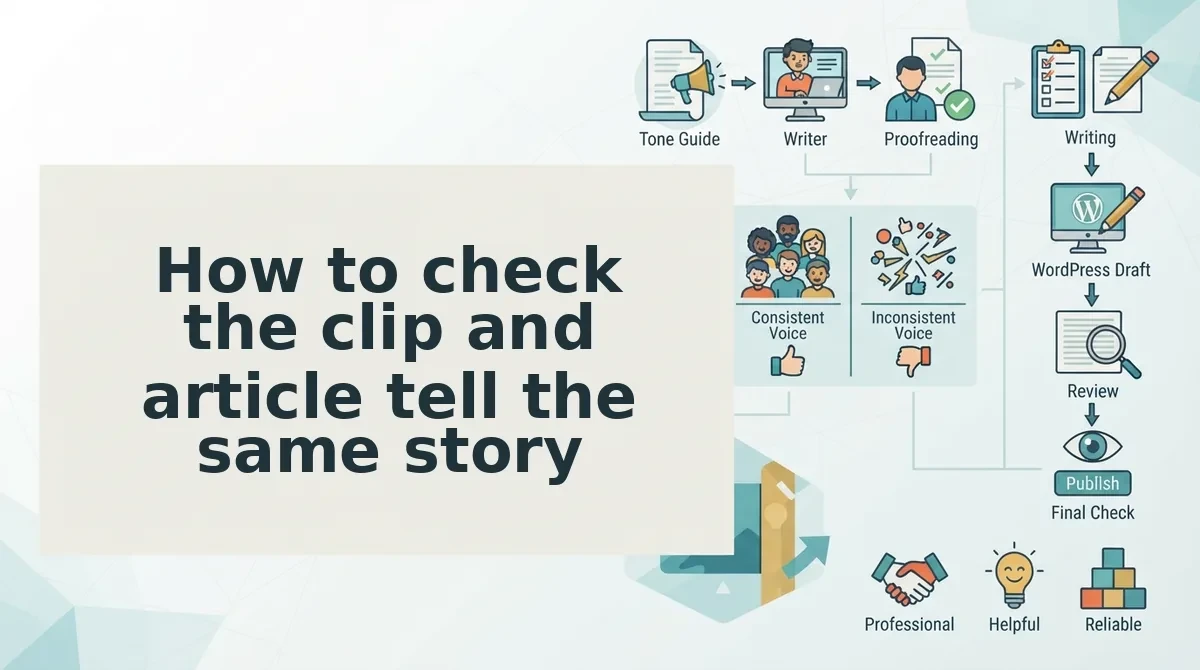
How to check the clip and article tell the same story
Run a claim ledger before either format goes live. A claim ledger is a two-column list of every factual claim in the clip and the article. It flags any claim that appears in only one format or has no live source page.
You need: the clip script or captions, the article draft, your message sheet, and a spreadsheet. Allow about 15 minutes.
- Open a new spreadsheet. Label column A "Clip" and column B "Article," then paste each claim into its own row. You should see every claim listed once (about 5 minutes).
- Mark any row with an empty cell. Pass: both columns are filled. Fix: add the claim to the missing format or cut it.
- Open the source page for each claim. Pass: the page is live and says the same thing. Fix: update the page or drop the claim.
- Compare the calls to action. Pass: both point to the same page with the same ask.
- Press Ctrl+F (Cmd+F on Mac) in both drafts and search each banned word. Pass: zero matches.
- Confirm the clip's main claim is the article's first H2. Pass: it matches in wording or meaning.
Worked example #3: A reviewer lays the clip captions next to the article draft and finds a feature named in the video but missing from the article. They add it before scheduling either piece. The tools draft, but you control the facts, the words, and what gets published.
One limit applies. The ledger only works if your site pages are current. For a deeper pass on the article itself, fact-check an AI-drafted article before it publishes.

FAQ about keeping video and blog messages aligned
These answers cover the questions most readers still have after building a message sheet and running a claim ledger.
Should the video say exactly what the article says?
No. The video and article should make the same claims in the same voice at different depths. The clip states one core claim quickly. The article explains that claim, adds context, and supports it with sources.
What if my website pages are out of date?
Fix the page first, because it is your source of truth. Content drafted from outdated pages repeats outdated claims in both formats, so update the page before drafting a clip or article.
Can AI tools keep the message consistent on their own?
No. AI tools draft from what your site already says, but they cannot judge whether a claim is current or on-message. You review each draft and decide what publishes.
Is consistency the same as posting often?
No. Consistency is about what you say, and frequency is about how often you say it. You can post daily and still contradict yourself. For more on this, see these practical perspectives on content workflows.
One feature, one sheet, one story
A consistent message comes from a repeatable routine. When every clip and article starts from the same sheet and passes the same ledger, your audience hears one story wherever they find you.
Three actions turn this into routine:
- Fill in the message sheet for your next feature.
- Write the clip claim first, then make it the article's first H2.
- Run the claim ledger before either piece publishes.
To draft both formats from the same site knowledge, explore the Growth Duo, which delivers short videos and researched articles in one subscription. It pairs Vlozy short videos with BloGoose researched articles under one PayPal subscription with separate logins. You review everything before it publishes, so each feature you ship can carry a message your audience recognizes everywhere.