
For a founder blog, a site-reading brand voice AI writer is usually the better fit when your website already explains the product. Jasper is usually the better fit when a marketing team will build and maintain voice profiles. That is the short verdict of this brand voice AI writer compared with Jasper.
Consider a common situation. You have shipped a new feature and need a blog post that explains it to customers. The AI draft you get back reads like every other launch post online, and you are right to be frustrated by that.
Roktim Saha, founder of Verthilix, describes his approach this way: "I watch where people struggle." For founders, the struggle is rarely a missing feature. It is where the tool gets its voice in the first place.
How does a brand voice AI writer compare with Jasper for a founder's blog? Jasper suits marketing teams that set up voice profiles and memories for many voices and workflows. A site-reading brand voice AI writer like BloGoose suits founders whose website already explains the product. With either tool, the founder still reviews every fact before publishing.
This guide compares the two tools by where the voice comes from, not by feature lists. It also covers how Jasper handles brand voice and one review check that most comparisons skip. That check matters more than which tool you choose. Verthilix builds software for business growth for founders, so the focus here stays practical.
Brand Voice AI Writer vs Jasper at a Glance
The core difference is the input. Jasper learns voice from profiles and memories that you write and maintain, while a site-reading writer like BloGoose drafts from the website you already have.
A brand voice AI writer is software that drafts content in a specific organization's tone, vocabulary, and point of view. It gets that voice from one of three sources: a written voice profile, stored product knowledge, or the existing website read before drafting.
Three terms are worth separating. Brand voice is how your company consistently sounds. A voice profile or style guide is a written description of that voice. Site-grounded drafting means the tool reads your published pages before it writes.
| Criteria (Voice Source) | Jasper | BloGoose (site-reading) |
|---|---|---|
| Where the voice comes from | A voice profile or style guide you provide | Your existing website, read before drafting |
| Setup effort | Higher: you write the profile and add memories | Lower if your site already explains the product |
| What keeps facts accurate | Stored memories or a knowledge base | Published site content |
| Review load | Founder or team checks facts and tone | Founder checks facts and tone |
| Built for | Marketing teams with many voices and workflows | Founders and small teams |
| Channels covered | Broad marketing content | Researched articles, plus Vlozy short videos through the Growth Duo |
| WordPress handoff | Check jasper.ai for current integrations | Built for researched WordPress articles |
To see the process difference, take the same new-feature explanation. In Jasper, the founder writes or uploads a voice profile, adds the product facts as memories, and then prompts the draft. With BloGoose, the tool reads the existing site first and drafts from what the site already says.
Jasper is a strong choice when you need one tool to manage several brand voices across campaigns, with dedicated people maintaining the inputs. BloGoose is the better choice when your website is already the clearest description of your product. In both cases, the founder still reviews every claim, because neither input model removes the need for a human fact check before publishing.
Best for marketing teams: Jasper. Best for founders whose site already explains the product: BloGoose. If you also want short videos, the Growth Duo pairs BloGoose articles with Vlozy videos in a single subscription.
How Does Jasper Handle Brand Voice?
Jasper learns your voice from profiles and stored knowledge that you set up. It is the consensus option, and its approach is well suited to teams that have the time to build those inputs.
- Brand Voice setup: You create a voice from a style guide or sample content, and Jasper uses it to shape tone and vocabulary. This matters because the quality of the output depends on the quality of that description. Start with your clearest existing writing as the sample.
- Memories or knowledge base: You store product facts so drafts can reference them consistently. This reduces generic claims, but only if the stored facts stay current. Update entries whenever a feature ships or changes.
- Multiple voices: Teams can keep separate voices for different brands, products, or audiences. This helps agencies and marketing departments switch between contexts. Name each voice clearly so writers pick the right one.
This model works best for marketing teams managing several voices and workflows. The trade-off for a founder is that someone has to write the inputs and keep them maintained, and on a small team that person is often the founder.
Most YouTube coverage of these features consists of setup tutorials and affiliate content, such as "Jasper Brand Voice & Memories: Surprising Use Case" from WordsAtScale. Treat those videos as background rather than evidence, since none of them take a founder's perspective. For a closer look at article workflows, see BloGoose vs Jasper for researched WordPress articles.
Editor note: verify current feature names on jasper.ai before publishing.
A site-reading writer starts from a different input.
How Does a Site-Reading Writer Like BloGoose Learn Your Voice?
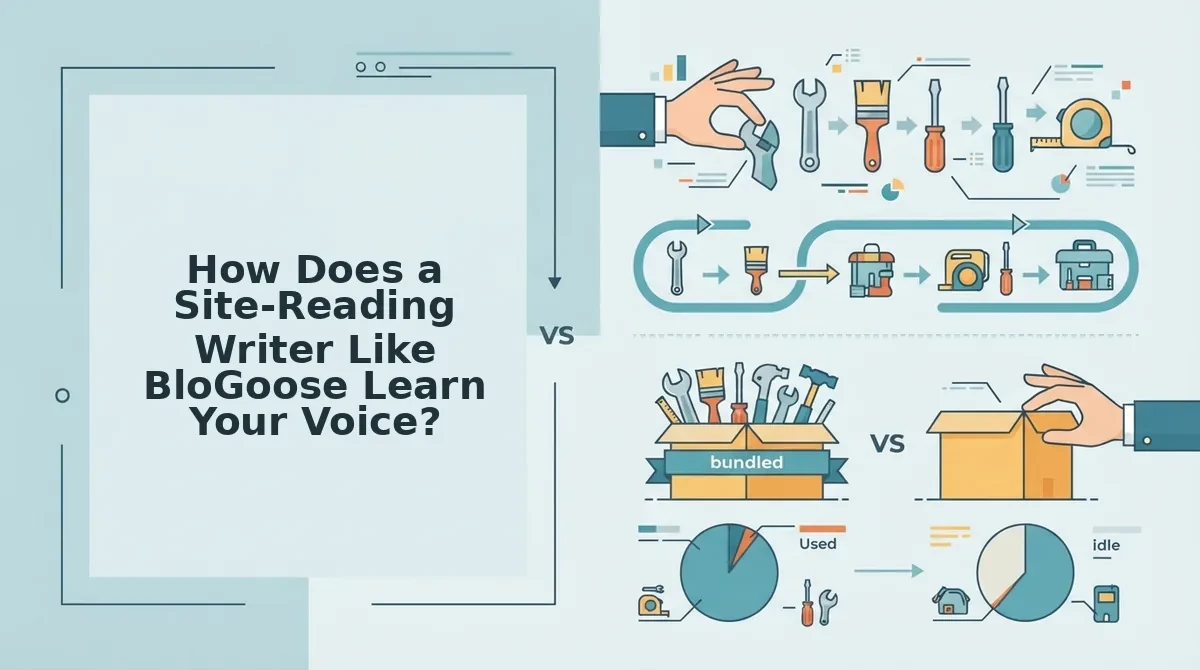
BloGoose reads what your website already says before it drafts. Its voice and product knowledge come from pages you have already written and approved.
Site-grounded drafting is an AI writing method in which the tool uses your published website as its source of tone, terminology, and product facts. It is one of three common voice sources, alongside a written style guide and pasted writing samples.
The simple version: a new hire who reads first
Picture two new hires. One gets a style guide and starts writing right away. The other spends the morning reading your homepage, product pages, and past posts before drafting anything.
The second hire picks up the phrases you actually use and the features you actually sell. That is the site-reading model.
The intermediate version: no separate voice document
A brand voice document is a standalone file that describes how you sound. Someone has to write it, update it when the product changes, and keep it consistent with the site.
For a founder without a marketing team, that file easily drifts out of date. A site-reading writer skips this step because your updated pages are the reference.
The advanced version: drafts, not auto-publishing
BloGoose sends the finished article to WordPress as a draft. A draft is a saved, unpublished post that stays in your dashboard until you approve it.
This reflects a Verthilix principle: you still review the facts, the words, and what gets published. The tool handles research and the first pass, and you make the final call.
BloGoose sits within the Verthilix product family, where each tool is built for a specific job such as communication or content creation.
Where BloGoose Falls Short and What to Review Before WordPress
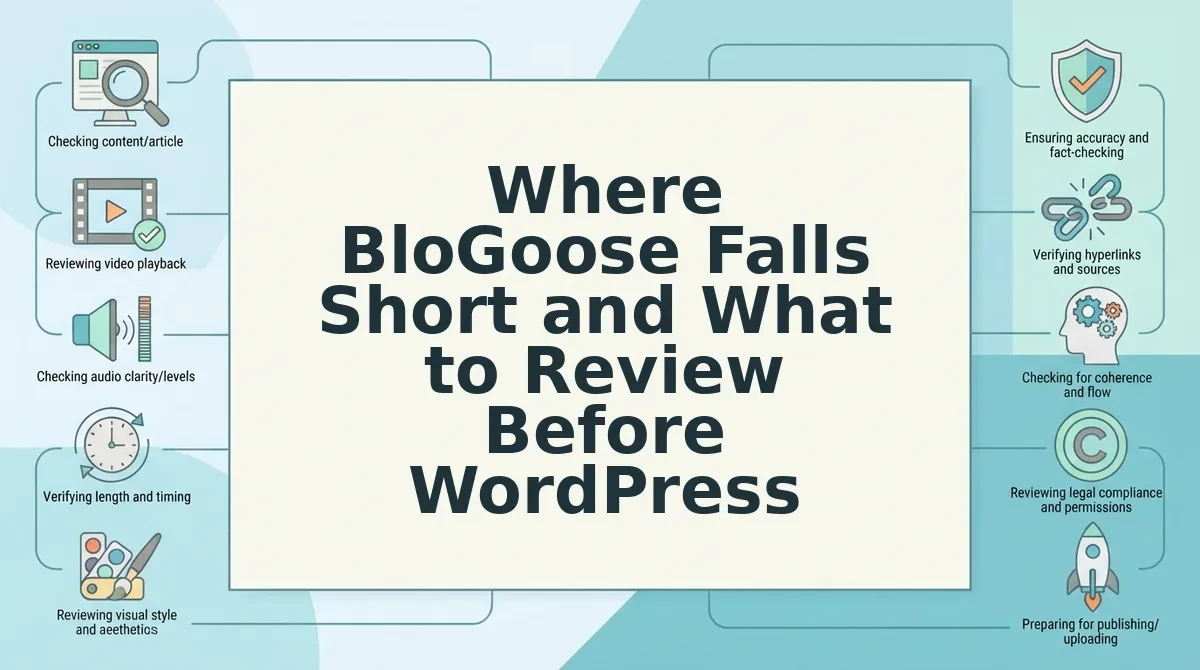
BloGoose is only as accurate and current as the website it reads, and it does not replace your review. Before publishing, check seven things: product facts, feature names, claims and numbers, banned phrases, the CTA, internal links, and whether you would say it aloud.
Honest limits
Thin or outdated pages produce thin or outdated drafts. BloGoose is built for one founder's voice, not for a marketing team managing many brands. The Growth Duo also uses separate logins for Vlozy and BloGoose.
The bigger risk is factual drift, not tone drift. A draft can sound exactly like you and still misstate a feature.
The 7-point pre-publish checklist
- Verify product facts. Compare every product statement with your current pages, because a stale page means a stale claim.
- Confirm feature names. Match each name to the exact wording on your site so readers do not search for features that don't exist.
- Check claims and numbers. Trace every figure to a source you can name, and delete any you can't.
- Remove banned phrases. Strip out words you never use, since one wrong phrase can make an accurate post feel generic.
- Test the CTA. Make sure the call to action points to an offer you actually sell today.
- Click internal links. Open each link to confirm it works and leads to the page the sentence promises.
- Apply the "would I say this aloud" test. Read the draft out loud and rewrite anything you would not say to a customer.
What should you check in an AI draft before publishing? Start with accuracy, then move to voice. Confirm product facts, feature names, and every claim or number against your live pages. After that, remove phrases you never use, check that the call to action matches a current offer, and click each internal link. Finally, read the draft aloud and rewrite anything you would not say to a customer, because an AI draft can match your tone perfectly and still get a feature wrong.
For a step-by-step method, see how to fact-check an AI-drafted article. BloGoose delivers posts as WordPress drafts, so this review happens before anything goes live.
Which Should a Founder Choose?
Choose Jasper if a marketing team manages several brand voices. Choose a site-reading writer like BloGoose if you are a founder whose website already explains your product.
| Team type | Best voice source | Review load | Channels needed |
|---|---|---|---|
| Solo founder | Your own website (BloGoose) | One person checks facts | Articles, often plus short video |
| Small team | Website, with a shared review step | Founder approves drafts | Articles and short video |
| Marketing team | Brand voice profiles (Jasper) | Editors across multiple voices | Many brands and formats |
Jasper's strength is real. It is built for teams that need many voices. For a solo founder, that structure is usually more than you need.
Worked example: A founder launches one new feature and needs an article and a short clip about it. With the Growth Duo, the same product knowledge produces a BloGoose article and a Vlozy one-feature video under one PayPal subscription, with separate logins for each tool.
Recommendation: If your site already explains your product, pair researched articles with short videos and let one source of truth feed both channels.
The simplest place to start is with what you have already published.
Start With the Voice Your Site Already Has
The best brand voice AI writer for a founder blog starts from what your website already says. Then you check every draft for facts, not just tone. That reframe is the finding this comparison promised.
A draft can sound like you and still misstate your product.
I build these tools because I'm a founder too. I'd rather put my name on the results than hand you another prompt library.
- Name your voice source. Point the writer at your live site, not a pasted style guide.
- Run the 7-point check on every draft before it reaches WordPress.
- Pick by team size. Several writers sharing one style guide may justify Jasper. A solo founder or small team usually goes further with a site-reading writer.
The payoff is drafts that need a fact pass, not a full rewrite. To get there, pair researched articles with short videos through one Growth Duo subscription. The Verthilix Journal has more practical content guides.
Your website already holds your voice, so the right writer reads it and you verify every claim it makes.